
 A student demonstrates his skill during the Colour Belt Taekwondo promotion test conducted by Faith in Action Taekwondo Academy on May 13. 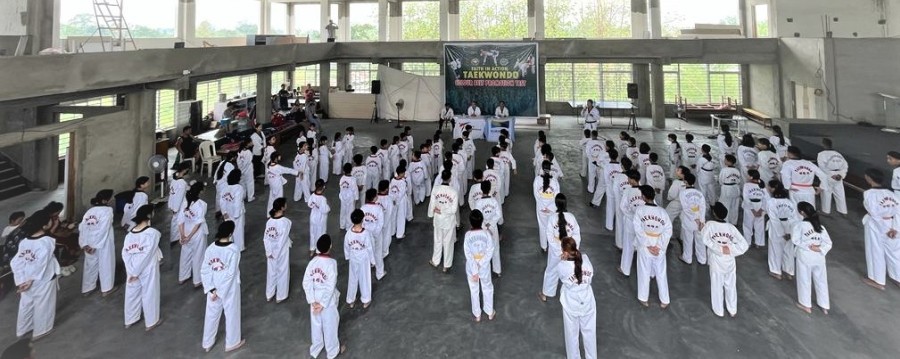 Students line up for their Colour Belt Taekwondo promotion test conducted by Faith in Action Taekwondo Academy on May 13. Students line up for their Colour Belt Taekwondo promotion test conducted by Faith in Action Taekwondo Academy on May 13.Dimapur, (MExN): The Faith in Action Taekwondo Academy conducted its Colour Belt Taekwondo promotion test on May 13 at Grace Academy, GC Paira Colony, Dimapur. A total of 156 Taekwondo players from Little Star Higher Secondary School, Grace Academy, Pranabananda Women’s College, Immanuel Taekwondo Academy, Little Angels School and Manic Taekwondo Academy appeared for their promotion test, informed a press release from the Academy. Matsungyanger, Nito Sema, Lidya Yepthomi and Kimeri of LSHSS and Wadankokba K Yaden of Grace Academy have obtained double promotion for their excellence in overall Taekwondo techniques during the test, it said. The Taekwondo Colour Belt Promotion test was taken under the World Taekwondo Academy’s curriculum, it added. Faith in Action conducts Colour Belt Taekwondo promotion test | MorungExpress | morungexpress.com |
A Real Life Barbie Dreamhouse For Sale on Zillow Goes Viral For Happy Seller in New Jersey (2025-06-14T12:23:00+05:30)
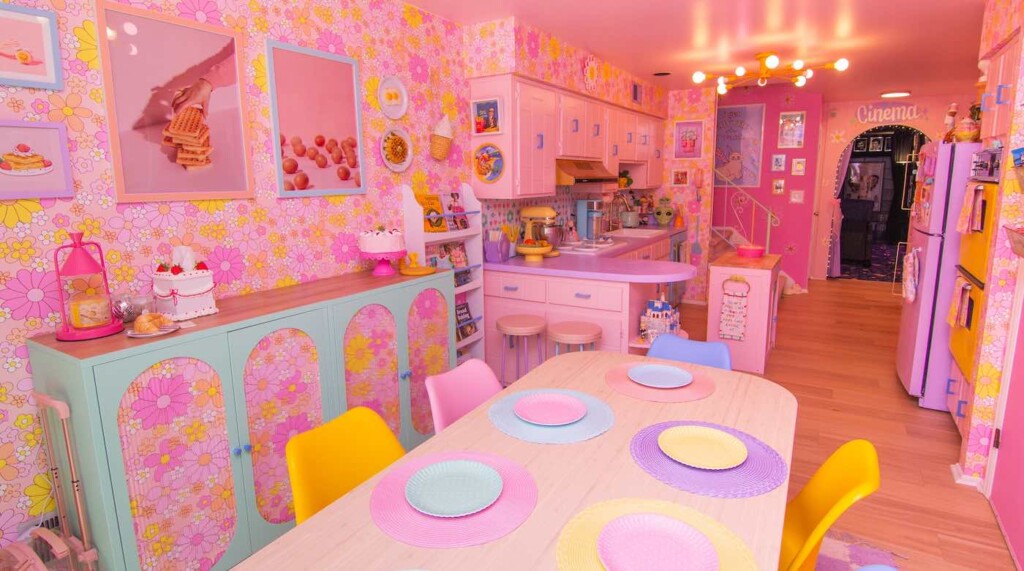 Kitchen of the Barbie dreamhouse for sale by Kate Gabrielle in Hamilton, New Jersey -SWNS Kitchen of the Barbie dreamhouse for sale by Kate Gabrielle in Hamilton, New Jersey -SWNSCheck out this positively pink full-sized ‘Barbie Dreamhouse’ for sale in New Jersey… The bungalow includes a cinema room, large walk-in wardrobe, a craft room, and a handbag wall—all in bright pinks and calming lavenders. The three-bedroom property on Hughes Drive in Hamilton Township has a unique style that may only be perfect for a Barbie superfan—but it’s charm has gone viral on the Instagram account Zillow Gone Wild. As soon as you walk through the pink front door you’re welcomed by daisy wallpaper which leads into a cinema with dark purple walls and rows of recliner seats. The Zillow listing says the two-bathroom home in the desirable neighborhood of University Heights has “good energy and good vibes,” and the asking price is $500,000. The owner of the home, Kate Gabrielle, says they already have potential buyers—some who wanted to keep the furniture and décor. It’s a “killer dopamine inspiration,” one commenter said on social media. “I feel like it would be impossible to have a bad day living here.”\ 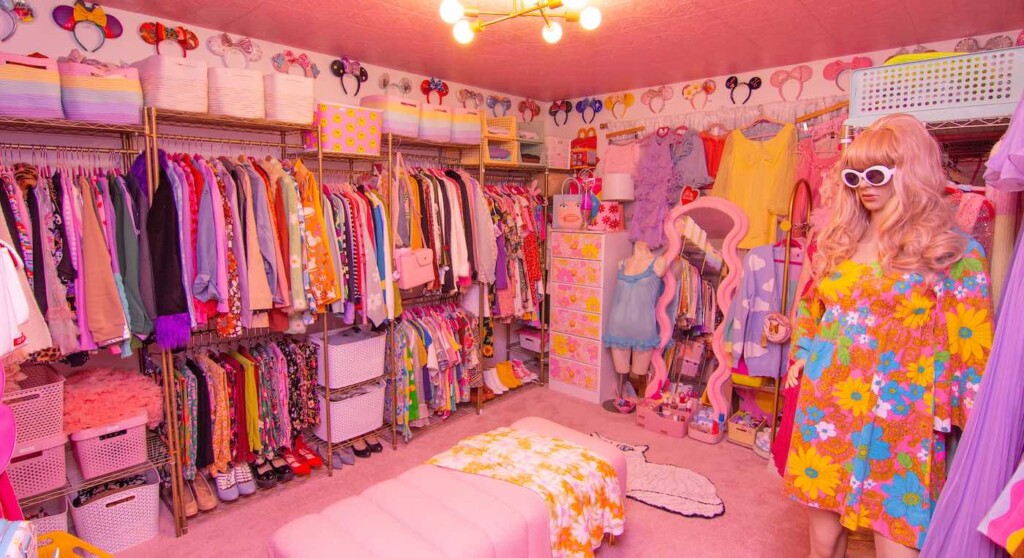 Kate Gabrielle’s Barbie dreamhouse in Hamilton, New Jersey – SWNS Kate Gabrielle’s Barbie dreamhouse in Hamilton, New Jersey – SWNSThe listing says, “Enter through a new screened-in front porch into this uniquely charming home that has new vinyl flooring throughout the main floor. New carpet in bedrooms and theatre and new custom tile in the bathrooms.” 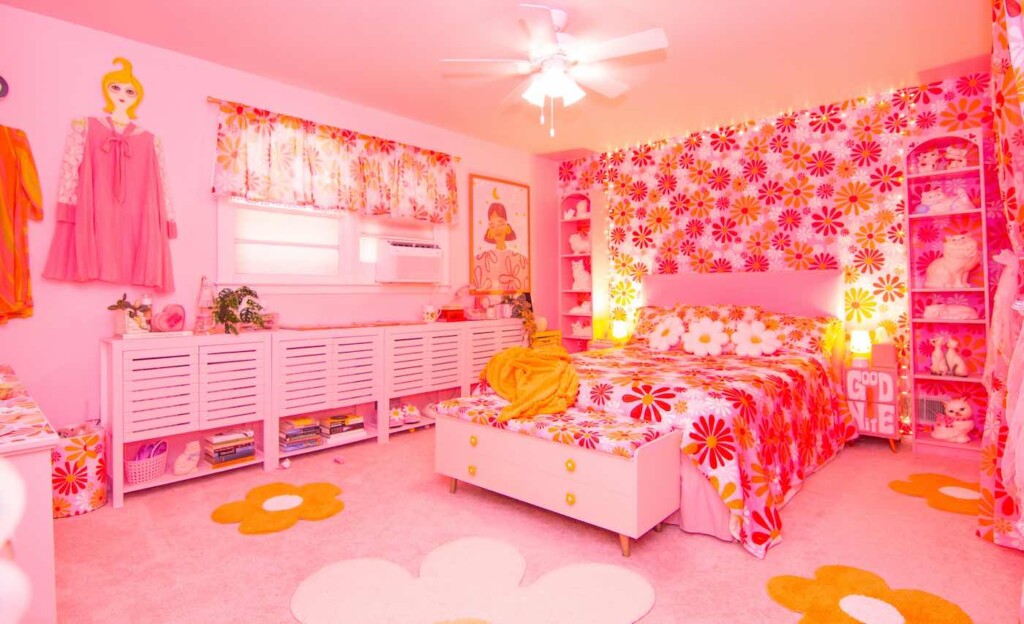 SWNS SWNSWhether you find it cheery or cheesy, we have to admire Kate’s passionate commitment to her own style. |
 SWNS
SWNS Designer fashion, nostalgia magnet - what’s behind the rise and rise of the sneaker? (2025-06-04T12:24:00+05:30)
In June this year, hundreds of Australian shoppers queued – some overnight – to buy a pair of Yeezy Boost 350 V2 Black Static Adidas sneakers the moment they went on sale. Before lining up, customers had to register and go into a draw to determine whether they could buy a pair. The shoes sold for a few hundred dollars but are now being traded for up to A$3000. This quest to obtain limited edition sneakers designed by rapper Kanye West is not an isolated phenomenon. People have long gone to extreme lengths to get their hands on the latest kicks. There have been reports of sneaker violence since the 1980s. For those wishing to form a more orderly queue, the internet has responded with news services and dedicated message boards to help people get the latest kicks. Other sites treat sneakers like stock market commodities. But how does society’s sneaker love tally with our awareness of the environmental and human cost of consumerism? A brief history The first sneakers appeared in 1830s England, when Liverpool Rubber bonded a canvas outer onto a vulcanised rubber sole, creating the original sand shoe for the Victorian middle classes to wear on the beach. Different styles of the shoe were developed in the UK and the US throughout the 19th century to respond to athletic pursuits like running, tennis, jumping and sailing. The term “sneaker” was coined in the US in the 1870 to describe the shoe because it was noiseless. Athletes in Paris wore sneakers at the first modern Olympic Games in 1900. The American pro-basketball player Charles H. Taylor, passionately promoted the sneakers designed by Marquis M. Converse in 1917. By 1923, Taylor’s improvements had been incorporated into the shoe, his signature added to their design, and Converse “Chucks” have remained unchanged since. Adidas was founded by the Dassler brothers in Germany in 1926, and Puma was founded in 1948 when the Dassler brothers split. Onitsuka Tiger (ASICS) were founded in Japan in 1949 and Reebok started making sneakers in 1958. New Balance started creating their “Trackster” sneakers in 1961, and Nike was founded in 1972. At every point, sneakers were created to support athletes, but also to promote lifestyles that connected leisure with physical activity. Since the 1970s, sneakers have been linked to skateboarding and hip-hop culture, including break dancing; urban pursuits that require a high degree of comfort and ease of movement. The explosion of hip-hop from the mid-1980s and its global dominance in the 1990s meant that sneakers quickly became a visual symbol of hip-hop and a symbol of its separation from the mainstream. Run DMC’s 1986 track, My Adidas was as much about the band’s love for sneakers as it was about how quickly people judged black youth who wore sneakers to be troublemakers. Likewise, when rave culture blossomed in the 1980s and 1990s, sneakers became the footwear of choice for the 24-hour party people who dressed to sweat. Sneakers today The current nostalgia in sneakers extends to design imagery, styles, and colour combinations. In April this year, Adidas issued a limited edition version of the My Adidas Superstar 1986 sneaker. Luxury brands have also taken note, capitalising on historical references, status concerns and a relaxation in social dress codes. Leading high-fashion brands, including Chanel, Louis Vuitton and Balenciaga now consider sneakers a must-have fashion item in their collections. Balenciaga’s recent Triple S sneakers (priced at around A$1300) echo the platform sneaker trends of the 1990s, with the company’s CEO Cédric Charbit, noting “sneakers … blend nicely with the way we live”. Where once 1980s women swapped their commuter sneakers for power heels at the office, people now wear their sneakers all day. Charbit believes the sneaker has become, “very versatile, it goes from day to night, it goes for the weekend, it goes for work”. Sustainability and ethical production While many sneaker fans continue to prioritise style over environmental concerns, others are demanding transparency around the ethics and impact of production, leading to the rise of the sustainable sneaker. Meghan, The Duchess of Sussex, favours Veja sneakers made from wild Amazonian rainforest rubber. Adidas has been making sneakers using recycled ocean plastic since 2015, but says it wants to go further. It launched the Futurecraft Loop in April, a sneaker made exclusively from 100% reusable Thermoplastic polyurethane that can be recycled again and again. Adidas, Brooks, Reebok, and Salomon showed positive working conditions at their factories in a 2018 survey, but there was still a problem with low wages. Sites like the Good Shopping Guide can help customers can make more informed choices. But sustainable fashion expert Mark Liu notes, “Sneakers are still extremely problematic because of all their toxic petrochemical components, glues and the amount of greenwash in the industry”. \ One key to enduring sneaker love is scarcity. Adidas only released 1986 of their limited-edition My Adidas Superstar 1986 shoes. West also generates exclusivity with low production numbers – only 40,000 pairs of Yeezys are made worldwide for each drop and shops in Australia may only have 25 pairs of each incarnation. The combination of rarity, and the myriad cultural meanings embedded in sneakers creates an emotional pull for collectors like DJ Jerome Salele’a that ties them to sneaker, hip-hop, skater and rave communities around the globe. The ultimate sneaker is a comfortable vehicle for the body to move through the world that expresses the wearer’s desires, dreams and aspirations and crosses social, geographic and language boundaries.  Emily Brayshaw, Lecturer, Fashion and Design History, Theory, and Thinking, University of Technology Sydney This article is republished from The Conversation under a Creative Commons license. Read the original article.
|
How fast food is reinventing itself as healthy and caring (2025-02-20T13:48:00+05:30)
| Public health campaigners, scholars, dietitians, journalists, politicians, filmmakers, celebrity chefs and the public frequently lambaste fast food corporations for causing and exacerbating the global obesity “crisis”. It is hardly surprising then that the global food and drink industry (also described by critics as “big food”) is keen to promote itself as “part of the solution”. In 2011, the International Food & Beverage Alliance (IFBA) – a formalised coalition between multinational giants Nestlé, General Mills, Ferrero, Kellogg Company, Grupo Bimbo, Mondelēz International (formerly Kraft Foods), Mars, PepsiCo, The Coca-Cola Company, Unilever (and recent addition McDonald’s) – wrote to Dr Margaret Chan, the Director-General of the World Health Organisation (WHO): “We all recognise that non-communicable diseases and childhood obesity are major public health problems that require multi-stakeholder solutions. As a member of the private sector, we firmly believe that the food industry has a role to play as part of the solution, and have committed our time, expertise and resources to do our part.” In order for the IFBA and its member companies to be seen to be providing “solutions” to obesity, corporate philanthropy has been employed as a key strategy. From ‘big food’ to ‘big philanthropy’ I use the phrase corporate philanthropy as an umbrella term to describe a range of practices (including corporate social responsibility, corporate citizenship, stakeholder management) whereby corporations “give” money, personnel, equipment and support to other organisations. This is a form of corporate giving that Samantha King and others describe as “strategic philanthropy”; a type of “philanthrocapitalism” that is intimately tied to the business interests of the corporation. Nestlé, for instance, states that its global nutrition, health and wellness program - Creating Shared Value - “is not about philanthropy. It is about leveraging core activities and partnerships for the joint benefit of people in the countries where we operate and of our shareholders.” Corporate philanthropy is, therefore, not simply altruism by another name. It is part of a business strategy to look after the financial interests of shareholders, penetrate and retain markets, and improve the bottom line. Fast food philanthropy ‘in action’ There are numerous examples of fast food philanthropy across the globe. Educational programs and resources are a key target of corporate philanthropy, particularly those that claim to promote healthy lifestyles. For instance, the “Nestlé Healthy Kids Global Program” has been implemented in 73 countries, including the “Nestlé Healthy Active Kids Program” in Australia and “Be Healthy, Be Active” in New Zealand. Kellogg’s created the “Mission Nutrition®” program in Canada. The Coca-Cola Company provided EducAnimando con Salud Program (“Teaching and Encouraging with Health”) in Peru, A Scuola inForma (“At School In Shape”) nutrition education program in Italy, and many more. Big food also uses philanthropic gifting to help market “active, healthy living” campaigns, such as The Coca-Cola Company’s “National Active Lifestyle Campaign” in Latvia and global advertisements that attempt to “teach” the public about the importance of energy balance. In the US, the PepsiCo Foundation partnered with Save the Children to implement its “Healthy Lifestyles” program, while the General Mills Foundation helped advertise the “Presidential Youth Fitness Program”, part of General Mills’ “community engagement mission [to] nourish our communities globally with remarkable philanthropy”. Sponsorship of sporting and physical activity initiatives is another critical element. These include The Coca-Cola Company’s “Get the Ball Rolling” initiative in the US, PepsiCo’s support of Caravano do Esporte (Sports Caravan) in Brazil, Mars’ partnership with the Al Haraka Baraka (“Movement is a Blessing”) physical activity program, and the “Champions of Play for the Olympic Games” from McDonald’s. Scientific research is also influenced by corporate philanthropy. For example, a number of people have recently criticised the Global Energy Balance Network (GEBN) for receiving “an unrestricted gift from The Coca-Cola Company”. There is a shared concern that this sort of funding “taints” research and evidence. Health-washing big food Philanthropy is more than just a strategy for big food to “solve” obesity. It is a business tactic to “health-wash” food and drink corporations and their products. By philanthropically funding various educational resources, physical activity initiatives, scientific research and marketing campaigns, big food attempts to divert the public’s attention from less agreeable, less healthy practices (e.g. junk food marketing, hidden sugar in processed food). Simultaneously, this philanthropy is a strategy that attempts to gain a “halo effect” for the corporation; an endeavour to shape consumers’ image of the corporation (and its products) as healthy, but also socially responsible, even caring. This is a new brand of philanthropy, one intrinsically tied to developing big food’s self-interest: brand image and loyalty, public relations, and avoidance of stricter regulations and legislation. For big food, obesity is no longer a big problem. In fact, obesity-related philanthropy is helping it profit.  Darren Powell, Lecturer Health and Physical Education, University of Auckland, Waipapa Taumata Rau This article is republished from The Conversation under a Creative Commons license. Read the original article. |
Parents can promote gender equality and help prevent violence against women. Here’s how (2025-01-16T12:03:00+05:30)
|
Gemma Hamilton, RMIT University; Anastasia Powell, RMIT University, and Naomi Pfitzner, RMIT University It’s only a little over halfway through the year and already 37 Australian women have been killed by violence. On average, at least one Australian woman is killed by a current or former partner a week, and about one in six women have experienced sexual or physical violence since the age of 15. Last month, the rape and murder of Melbourne woman Eurydice Dixon again ignited national conversation about preventing violence against women. What’s driving this violence? Rigid gender roles and stereotyped constructions of masculinity and femininity are key drivers of violence against women. And a large body of academic research shows traditional attitudes towards gender are one of the strongest predictors of attitudes that support this violence. Australia’s world first national framework to prevent violence against women identifies challenging rigid gender roles and stereotypes as a key action in preventing such action in the first place. To create lasting change, prevention needs to encompass multiple strategies across a range of places in our community. One key strategy is to begin early in the home. Start early, at home Early childhood is a key developmental period when children begin to learn about gender. Gender is different from a person’s biological sex. A person’s sex is based on physical features such as anatomy, hormones and reproductive organs. Their gender is the way they think and act based on learned roles and social expectations. From birth, children learn about gender-appropriate attitudes and behaviours through gender socialisation. They learn to “do” gender through internalising gender norms and roles as they interact with people around them. Families are primary agents of gender socialisation, and often provide children’s first sources of information and learning about gender. Children begin to understand and act out gender roles and stereotypes at an early age. The degree to which they internalise and adopt stereotyped attitudes and behaviours can have long term effects on their attitudes, behaviours and values. People who support rigid gender roles and relations are more likely to endorse attitudes that justify, excuse, minimise or trivialise violence against women, or blame or hold women at least partially responsible for the violence against them. Not all boys who play with trucks are going to end up violent. But traditional masculine gender roles and ideologies (for example, “men need to be tough”) are associated with men’s violence against women. Researchers have yet to carry out longitudinal (long-term) studies to directly track the impact of early education in the home on outcomes related to gender equality and violence against women. However, research suggests parents can play an important role in promoting gender equality and building children’s resilience to rigid gender stereotypes in early childhood, a key action to prevent violence against women. What practical things can parents do at home? Parents first need to become more aware of rigid gender stereotypes and consciously question their existence, necessity and impact. Parents often implicitly reinforce gender stereotypes, even when they intend not to. For example, parents can convey messages about gender appropriate emotions and activities when reading their children storybooks. For instance, they might label gender-neutral sad characters as girls and angry characters as boys. Parents can also promote gender equality by supporting a range of activities for both their sons and daughters. Why not ballet? From infancy, boys are often given more sports equipment, toy cars and tools, while girls are given more dolls, kitchen appliances and pink clothing. Yet infants often have equal and overlapping interests in toys and it is the gendered marketing of toys that subsequently influences their preferences as they age. What resources are available? Interactive techniques, like role-playing, storytelling and games can help teach children about gender equality. For example, parents and children can play a printable card game or similar activity to match female and male characters doing the same profession. In Australia, parents can use resources from the #BecauseWhy campaign, launched this year to encourage parents to challenge rigid gender stereotypes and promote diverse interests with their young children. The campaign, run by Our Watch, involves digital resources including a website, short films and online articles. The Everyday Q&A page offers practical tips for how parents can challenge rigid gender stereotypes by talking with their children and others. For example, in situations when children might say, “tea sets are for girls”, the campaign suggests prompting a conversation about why the child thinks that, and offering an alternative view. That might be, “I can see why you think that, but don’t you think it would be great if we could all play with whatever we want? How about you pick any toy you want?”. Parents can’t do it alone It is impossible for parents alone to comprehensively change gender relations. However, when accompanied by other community interventions, for instance in schools and in the workplace, early childhood is a prime opportunity to create effective change. Supporting parents to promote more diverse concepts of gender with their young children may reduce rigid gender stereotypes tied to attitudes that support violence, and create a more gender equitable community in the long term.  Gemma Hamilton, Researcher, Gendered Violence and Research Alliance, RMIT University; Anastasia Powell, Associate Professor and ARC DECRA Fellow, Criminology and Justice Studies, RMIT University, and Naomi Pfitzner, Research Associate with the Gendered Violence and Abuse Research Alliance, RMIT University, RMIT University This article is republished from The Conversation under a Creative Commons license. Read the original article. |
Working the system: 3 ways planners can defy the odds to promote good health for all of us (2024-12-06T12:45:00+05:30)
|
Jennifer L. Kent, University of Sydney, Many of the chronic and costly diseases Australians face are related to how we live in cities. The speed of modern life clashes with poorly designed urban areas. As a result, health-promoting activities, such as regular physical activity, community interaction and the preparation of healthy food, become low priorities.
We know better urban planning can encourage healthier behaviours. Providing infrastructure for walking and cycling is a prime example. Yet there are other, often overlooked, ways that urban planners are on the front line when it comes to promoting the health of Australians. In particular, the way cities are planned can reduce inequities in both access to health services and health outcomes. This has important implications for the health of individuals and their communities. Urban planners are well versed in the fundamentals of planning the equitable city. But planners must work within the constraints of our political systems and prevailing approaches to government. Our recent analysis of health and urban planning in Australia identified a few key ways urban planners can “work the system” to promote health equity. Why is equity so important for health?Promoting equity is important for health because there is a social gradient to the differences between people’s health. In general, the higher a person’s socio-economic position, the healthier he or she is. People from poorer social or economic circumstances have higher rates of illness and disability, and live shorter lives. Differences in life expectancies across the nation illustrate this. In 2016, a man born in remote New South Wales had a life expectancy 13 years less than a man born in the affluent suburb of Mosman in Sydney. To promote equity, we need to define what we are seeking to equalise. In this case, it is the distribution of the social determinants of health. These determinants are the conditions in which people are born, grow up, live, work and age. Factors such as income, education, employment, empowerment and social support can strengthen or undermine health and well-being. Our planners have access to the data and the grounded knowledge required to expose gaps in services. For example, a local infrastructure planner can readily identify the communities that lack internet broadband access but need it. A transport planner working for Sydney’s City Rail knows all too well which train service is unreliable, and which train station is routinely missed during the peak because of overcrowding. Planners also have the skills and insights to raise concerns about shortages of residential housing stock, before these trigger the kind of housing affordability crises we have seen recently in Australian cities. The real challenge for planners promoting equity in Australia is the need to work within the constraints of the nation’s dominant political economy. In Australia today, we have a neoliberal system, epitomised by “the subjugation of the public to the private, the state to the market, the social to the economic”, as John Clarke put it. The result of this has been a progressive withdrawal of government involvement in many areas since the latter half of the 20th century.
Our recent analysis of health and urban planning in Australia provides several recommendations on how urban planners can work within this system to promote health equity. Play to emotionsThe first is to harness the power of human health’s emotive appeal. Relative to other planning concerns, such as environmental sustainability, health is an issue that appeals more directly to the individual. By making clear the links between good planning principles and human health, planners can leverage this emotion to promote concepts that might otherwise be ignored in developer-driven agendas. The protection of green open spaces for physical activity and community connection is a good example. By pointing out how important these things are for human health, urban planners can make a compelling and robust case for preserving these spaces. Speak the language of moneyA second way that planning for health can leverage space in a neoliberal system is to speak the language of the market. In 2016-17, Australia spent A$180.7 billion on health. This spending increases from year to year, outpacing growth in inflation, population or the economy. Most of this funding is dedicated to treating people once they are sick, rather than preventing illness. But prevention would produce large cost-savings. These savings can be captured in decision-making tools such as cost-benefit analysis. Planners are in a powerful position to work with public health professionals to develop a deeper understanding of the health cost savings to be made from better urban planning decisions. Enlist trusted figuresFinally, health can be promoted by harnessing the power of the health fraternity. Australian research shows the voice of a well-versed and respected individual can often make the difference when it comes to preserving a piece of open space, funding a cycleway or protecting the use of land for farmers’ markets. Australians hold health professionals in high esteem. Polling company Roy Morgan conducts an Image of Professions Survey, asking Australians to rank 30 professions by characteristics such as ethics and honesty. Medical professionals, such as nurses, doctors, pharmacists and dentists, have consistently featured in the top five. These trusted professionals could be influential voices for healthy built environment agendas. Our cities can and should be places that promote good health for everyone who lives in them. Quite simply, this means the (re)prioritisation of well-being over economic growth. This is a crucial barrier to planning healthy built environments in Australia. Yet it is not insurmountable. Indeed, the key to overcoming it may well be harnessing the power of health as a significant concern for all. The ideas in this article are taken from a new book, Planning Australia’s Healthy Built Environments. Join Jennifer Kent at the Festival of Urbanism in Sydney on September 9 to explore these issues. Jennifer L. Kent, Research Fellow, Urban and Regional Planning, University of Sydney This article is republished from The Conversation under a Creative Commons license. Read the original article. |

Melorra jewelry brand opens store in Dimapur (2024-05-17T14:28:00+05:30)
 Dimapur | May 10, Melorra, an Indian jewelry brand known for its trend inspired diamond and gold accessories for women launched its first store in Nagaland at Tajen Ao road, Dimapur which was opened by Advisor for Food & Civil Supply, KT Sukhalu and Amitoli Sema, wife of Advisor, H Tovihoto Ayemi on May 10. The event was also attended by Advisor for Transport and Technical Education, Temjenmenba. Under the tagline of ‘Every Fine Jewelry,’ the outlet will provide a wide range of accessories for customers to choose from. Started in 2016 by Saroja Yeramilli, the brand has operated based on the concept of ‘forever young and beautiful.’  Speaking on behalf of the promoter’s family, Shantaram Jonnalagadda shared that, “when we first started, we felt a need in the market for young women to wear trendy and fashionable accessories to go with the clothes they wore.” “If you look at Melorra, we are the only jewelry company in the world which looks at fashion for  inspiration,” he said. The company relies on scouts who looks at the latest trends featured in Milan and Paris Fashion weeks, brings those ideas back for the jewelry designers to make it into a reality, he explained. “Just as Zara and H&M launch new clothing wear every week, we launch new designs every week,” he stated. The company purportedly launches about 50 new designs every week. Prices of their accessories range from anywhere within Rs 40,000 to Rs 2,00,000 lakhs. Melorra’s Dimapur store will be the company’s 34th store across the country with an aggressive expansion plan of reaching 300 stores in the next four years, Jonnalagadda revealed. All the gold and diamond products at the store are certified, he added with purity for gold beginning at 22 karat and diamond at 18 karat. Along with the products, we provide an IGI certificate as well, he said. Melorra jewelry brand opens store in Dimapur | MorungExpress | morungexpress.com |
Bosses love boldness– simply asking could snag you a promotion in 2024 (2024-03-14T11:50:00+05:30)
 More than a quarter of UK leaders (28%) say they make decisions about who to promote in their organisation based simply upon whether somebody has asked for a promotion or not, according to a survey of more than 2,000 employees and managers by global leadership experts Right Management. Nearly a fifth (18%) of employees meanwhile, say that they don’t know how to go about advancing their career, while a quarter (24%) say they need greater clarity around what they need to do to progress, to help them to gain a promotion. “Asking for a promotion or support with your career development might not guarantee anything,” says Lorraine Mills, principal consultant, Right Management. “But it’s clear that it will significantly increase your chances.” “The old adage, ‘If you don’t ask, you don’t get’, comes to mind,” she adds. “As workplace dynamics become more complex, widespread and reliant on technology, we can sometimes forget the most obvious ways of going about things.” Responding to the survey, a quarter of leaders (26%) say they decide who to promote based on whether they think somebody will fit in, with 16% also saying such decisions are made on gut feeling. Thankfully a majority (57%) of leaders say they rely on data about people’s skills and abilities to decide who to promote. But employees might be interested to learn that it is loyalty and longevity of service that will also put them in good stead for a promotion, with 29% of leaders saying they base employee promotion and development decisions on the number of years somebody has worked at a company. This climbs even higher – to 42% – for respondents who are sole leaders, such as CEOs, founders and business owners. “It’s striking just how many leaders will admit that a long stint of service by an employee, as well as their own personal instincts, are such important factors when deciding who to promote”, says Mills. “It could be tempting to think that gut instinct and years of service might offer some advantages for leaders if they are combined with other subjective measures, but such measures should never be used to make key decisions, as there is too much danger of bias.” However, there appears to be some misalignment between employees and leaders on the topic of promotion. While most leaders cite these decisions as being data-driven, one in five employees (22%) believe such decisions are based on who you know, rather than what you know. “Leaders need to make sure their methods for deciding who to promote and develop are transparent and evidence-based,” says Mills. “It’s also important they nip potential issues in the bud by addressing any misperceptions in their workforce about how employees are promoted. “The way to promote and develop colleagues properly must be grounded in an inclusive and honest culture. When such decisions are made, communication and clarity is absolutely key. The wider business benefits when everybody understands why, and how, individuals have been promoted. That means line managers having all the necessary information readily available so that there cannot be any doubt or speculation around the process.” Bosses love boldness– simply asking could snag you a promotion in 2024 |
Selena Gomez's Indian avatar: Sari, bindi, bangles (2014-05-29T20:03:00+05:30)

May 24 Hollywood singer and fashion icon Selena Gomez took a break from wearing sensual dresses and skirts, to drape a traditional Indian sari and completed the look with bindi, bangles and a neckpiece. The 21-year-old, who is reportedly in Nepal on a mission as a UNICEF goodwill ambassador, managed to mesmerize her fans by her India-inspired look in an orange sari and a bindi matched up perfectly with open wavy hair. She posted a photograph of herself in this 'desi avatar' on photo-sharing website Instagram, and wrote: "Sari, not sari." The message was accompanied with a "Namastey" symbol with joined palms, though it was not revealed whether she was wearing a designer sari or not. However, this is not the first time Gomez has donned a bindi. She wore it first for the video of her hit song "Come and get it". Since then, she liked this fashion accessory so much that she opted for it several times. Gomez was also spotted with a bindi in Tarzana, California earlier this year. She again posted a picture of herself with a bindi March 4 this year. Celebrities like Madonna, Vanessa Hudgens, Sarah Hyland and Kendall Jenner also showed their love towards the bindi in the past. Source: Article, Image: flickr.com
|

Myntra unveils Hrithik Roshan’s brand HRX - Apparel (2014-03-13T23:33:00+05:30)
 Bollywood actor Hrithik Roshan joined hands with Myntra.com to exclusively launch and manufacture his active lifestyle apparel and casual wear brand HRX – Push Your Extreme. The collection is a combination of style and substance with inspiration drawn from the actor’s active lifestyle. The range includes casuals and easy active wear in apparel along with sports footwear for men. These products are lightweight and made of premium fabrics crafted with a contemporary slim fit. The entire collection sports vibrant colours and brings the active lifestyle fashion on par with global fashion trends. On partnering with Myntra.com, Roshan says, “I always envisioned HRX to be a platform that could inspire people to bring out their best and to never give up. My team, Afsar Zaidi from Exceed and Sid Shah from The Wild East Group have taken my philosophy and turned it into a brand. Speaking on the launch, Mukesh Bansal, CEO and Co-Founder, Myntra says, We are very excited about the opportunity to build original indigenous brands in India. Hrithik Roshan has massive fan base and is widely respected for his passion for fitness. HRX is a very innovative brand with leading edge fashion that seamlessly merges active lifestyle, global fashion trends & Indian tastes. Source: Article, Reference-Image: https://upload.wikimedia.org |
Katy Perry Killer Queen Fragrance Review (2014-03-04T21:08:00+05:30)

By Smaranda: Katy Perry has just launched her 3rd fragrance yet: Killer Queen, the first done in collaboration with Coty. Personally, I wasn't a fan of Katy's previous two scents; the good news for me is that Killer Queen marks a departure from its predecessors and it is a definite improvement. The new licensing partnership with Coty is a good move for Katy;when it comes to celebrity scents, Coty is the biggest player on the market. Beyonce, Jennifer Lopez, Lady Gaga, Sarah Jessica Parker, Kate Moss, David Beckham are some of the big names included in Coty's ever-growing portfolio of celebrity fragrances. Killer Queen has been announced as a playful, powerful, edgy and delicious fragrance, with top notes of wild berries, dark plum and bergamot, middle notes of red velvet flower (Celosia), Sambac jasmine and rainbow plumeria, over a base of cashmeran, patchouli and liquid praline. (Plumeria is a sweet tropical flower, also known as frangipani and cashmeran is a synthetic musky note designed to replicate the texture of cashmere.) Citing some of the influences that inspired her in choosing the right scent and packaging, Katy Perry mentions fragrances like Thierry Mugler's Alien and Tom Ford's Black Orchid:“I wanted some floral [notes], like jasmine...it does have a bit of a gourmand thing to it. I wanted the scent to have a little bit of ambiguity. I was attracted to scents in the last couple of years like Alien by Thierry Mugler and Black Orchid from Tom Ford. They’re too strong for me to wear all the time, and I didn’t want to them to be [copies], just to have a hint of ambiguity like they do. It’s sophisticated, but it’s not alienating my main group of people. The patchouli heart gives it ambiguity and this thing called cashmeran is really cool. It has this real curve ball in it that I think is sophisticated but still super sexy.” (WWD) As far as the packaging goes, Katy was inspired by the quirky, non conventional presentation of Jean Paul Gaultier's fragrances: “One thing I was really inspired by was Jean-Paul Gaultier’s fragrances, time after time after time,” said Perry. “There was the snow globe [Fragile], he was doing a bust [Signature], he was doing this or that. But he always did something that made me want to keep the bottle as a keepsake afterwards. I felt cool if I had one on a shelf in my room, even if there was no juice left in it. That inspired me. There isn’t any point for me to put out something that doesn’t stand out — because that is so not like me.” (WWD) Upon first spray, Killer
Queen opens with fruity notes, mainly a mix of plum and berries, although I can pick up some citrus accord right at the beginning as well (coming from the bergamot). This is not an extremely fruity scent and you don't have to wait too long for the middle and base notes to shine through: the mix of florals and the patchouli base with added sweetness (from the praline note) are noticeable right from the start. It is actually well blended and more grown-up than Katy's previous scents. Killer Queen is not a fruity floral, and I wouldn't call it a floral oriental (floriental) either. I would say it follows the current trend of the 'fruitchouli", that is scents that have a fruity opening over a prominent sweet patchouli base (with the middle often being a combo of floral notes). It is a fun, potent scent, with good lasting power on my skin. If you are wondering what other scents I would compare it to, just to give you a better idea about how it smells, I would say it falls in the same category with Viktor & Rolf Flowerbomb and Jimmy Choo Eau de Parfum. If sweet, patchouli-based scents are your thing, then Katy Perry Killer Queen should go on your list. Katy Perry's Killer Queen is available as 15 ml, 30 ml, 50 ml and 100 ml Eau de Parfum and you can find it in stores now, Source: Smartologie.com
|