
|
When Amazon started showing ads to its Prime Video subscribers, annoyed TV viewers complained to the consumer watchdog. Now the case is headed for the Federal Court – and already attracting international interest. The Australian Competition and Consumer Commission (ACCC) has accused Amazon Australia of breaching Australian consumer law by “making negative changes” to contract terms for Prime subscriptions, which then affected more than 850,000 people when Amazon introduced advertising to Prime Video. Amazon Prime Video is Australia’s second most popular streaming service, only behind Netflix. The ACCC says Amazon US was also “knowingly concerned” in what happened in Australia. This court case is part of a campaign by the ACCC to enforce the protections in the Australian Consumer Law against big companies – such as Amazon, Coles and Woolworths – involving individually small, but widespread, losses to consumers. Just last month, the ACCC launched a separate court case against Amazon for allegedly unsafe children’s backpacks. The ACCC is increasingly testing the boundaries of what it can enforce under Australian Consumer Law. But what exactly does that law say on this issue – and what defence might Amazon have? What’s the ACCC alleging? The ACCC alleges that between November 2023 and August 2025, Amazon Australia’s Prime contracts contained terms allowing Amazon to make changes to the service and conditions of supply, providing consumers were notified of any adverse changes. The ACCC alleges Amazon relied on these legal terms to:
At the time, more than 850,000 Prime subscribers had paid an annual fee for their subscription, which included access to Prime Video. So the ACCC argues those subscribers were then left with “a degraded Prime Video service for the balance of their subscription”. It also alleges consumers who chose to cancel were not offered “a pro rata refund or other meaningful redress”, which it argues made the terms of the Amazon contract unfair. Significantly, the ACCC also claims Amazon US was involved: that it made the decision to introduce advertising to Prime Video globally, then helped implement that decision in Australia. What Amazon has said and potential penalties An Amazon Australia spokesman said in a statement the company was reviewing the ACCC’s case:
The ACCC is seeking penalties against both Amazon Australia and Amazon US, as well as consumer redress and costs. In this case, the maximum financial penalty would be whichever is highest out of:
Why this case is legally tricky I have argued for years that “unilateral variation clauses” – giving the supplier an unfettered discretion to change the terms of service in a contract – are inherently unfair. The whole purpose of entering into a contract is to lock in a promise to supply goods or services on agreed terms. If the supplier – in this case Amazon – can change the terms at any time, in any way it likes, it undermines the whole point of making a contract. That’s been my view. But the ACCC’s official advice to business on contracts has taken a different position – which might give Amazon a defence. Amazon appears to have followed official guidance The ACCC’s own website currently suggests that a fair contract should allow consumers to terminate without a “penalty” if they don’t like a “unilateral change” from the supplier. This guidance does not explicitly mention needing to offer pro rata refunds for people cancelling contracts. This could be part of Amazon’s defence in the Federal Court. Amazon could argue its contract terms at the time were technically consistent with the ACCC’s own guidance: customers were given notice of adverse changes and could terminate at any time in response. The question for the Federal Court to decide will be whether that was enough – or whether pro rata refunds for Prime Video viewers wanting to cancel their subscription were essential to make the contract terms “fair” under consumer law. Interestingly, I checked my Amazon Prime Video subscription and found a pro rata refund is now offered if I terminate following an adverse change of terms. The ACCC has also pointed out that change in its case filing against Amazon. This court case will not just be closely watched here in Australia. With Amazon US also involved, within hours of the ACCC’s announcement it had already begun to make international headlines. The case will also be followed particularly closely in other countries with similar laws to Australia’s against unfair contract terms, such as the United Kingdom and the European Union. Jeannie Marie Paterson, Professor of Law (consumer protections and credit law), The University of Melbourne This article is republished from The Conversation under a Creative Commons license. Read the original article. |
Amazon is being taken to court for introducing ads to Prime Video. The world will be watching (2026-09-22T13:06:00+05:30)
 Jakub Zerdzicki/Pexels,
Does ‘free’ shipping really exist? An expert shares the marketing tricks you need to know (2026-04-01T11:24:00+05:30)
|
You’re scrolling through an online retailer, like Amazon, Shein or eBay, and spot a shirt on sale for $40. You add it to your cart, but at checkout, a $10 shipping fee suddenly appears. Frustrated, you close the tab. But what if that same shirt was priced at $50 with “free” shipping? The likelihood that you would have bought it without a second thought is much higher. COVID changed the way we shop and accelerated our reliance on e-commerce. But as online sales have grown, so has the expectation of free delivery. The reality, however, is that shipping physical goods is never actually free. Retailers use subtle marketing strategies and psychological hacks to mask these costs. As a result, consumers are often the ones footing the bill. The magic of zero There is something uniquely attractive about the concept “free”. In behavioural economics, zero is not just a lower price; it flips a psychological switch. When a transaction involves a cost, we instinctively weigh the downside. But when something is entirely free, we experience a positive emotion and perceive the offer as more valuable than it is mathematically. Retailers no doubt realise that offering free delivery is one of the most effective ways to stop a consumer from abandoning a digital shopping cart. The minimum spend trap Perhaps the most common marketing tactic is the free shipping threshold. Sometimes this is phrased as: “Spend $55 to qualify for free shipping.” If your shopping cart is sitting at $40, you face a dilemma. You can pay $10 for postage, or you can find a $15 item to reach the threshold. Many of us choose the latter, reasoning it is better to get a tangible product, such as a pair of socks, than to “waste” money on shipping. This tactic uses the “goal gradient effect”, which describes the tendency to put in more effort the closer we get to a goal. It also works incredibly well for the retailer. Research shows that free shipping increases both purchase frequency and overall order size. Policies with a threshold for free shipping often prompt this exact “topping up” behaviour. The consumer ends up buying things they did not initially want, thus boosting the retailer’s sales. 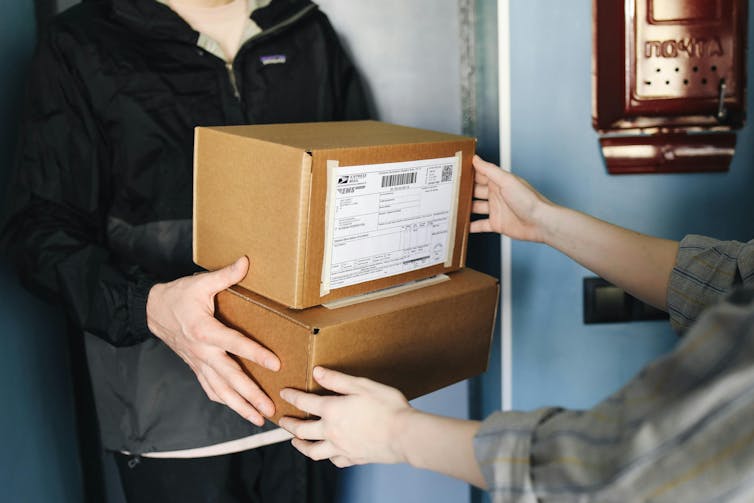 Minimum spend threshold marketing ploys are encouraging consumers to spend more to ‘avoid’ shipping costs. Polina Tankilevitch/Pexels Minimum spend threshold marketing ploys are encouraging consumers to spend more to ‘avoid’ shipping costs. Polina Tankilevitch/PexelsBaked-in costs and the reality of ‘free’ returns Another strategy is unconditional free shipping, where the delivery cost is simply baked into the product’s base price. This allows consumers to avoid the “pain of paying” a separate fee at checkout. However, we are still paying for the postage through higher item costs. For retailers, offering unconditional free shipping without a markup can be difficult to sustain profitably. The bump in sales usually does not offset the lost fee revenue and the costs of fulfilment. A major reason for this lack of profitability is that free shipping leads to significantly higher product return rates. Consumers tend to make riskier purchases if the appearance of waived fees lowers the perceived financial risk of the transaction. For example, you might order the same shirt in two different sizes, knowing you can just send one back for free. Who pays for that added convenience? The retailer, who now has to cover the courier fees twice. The retailer usually won’t simply absorb this cost, but will have to pass it on in other ways. The subscription illusion To combat these unpredictable costs, many businesses are turning to membership, loyalty, or subscription models such as Amazon Prime. Consumers pay an upfront annual fee in exchange for “free” expedited shipping year-round. Membership-based programs successfully increase customer loyalty and purchase frequency, and allow for better customer segmentation. But in the long run, they may actually hurt a retailer’s profit margins. While loyalty rises, the operational costs of fulfilling many smaller, free-shipped orders can potentially outweigh the benefits if not strictly managed. For the consumer, this model manipulates our “mental accounting”. Because we view the upfront fee as money already spent, every additional purchase feels like it comes with a free perk. We end up shopping more frequently on that specific platform just to “get our money’s worth”. Don’t buy the illusion The age of limitless free shipping may be coming to an end. As global supply chain costs remain volatile, we are likely to see retailers raising their minimum spend thresholds, removing offers, or increasing base product prices to compensate. The next time you are shopping online, resist the urge for instant gratification. If you are about to add a $15 pair of novelty avocado socks to your cart, just to save $10 on shipping, take a step back. Ask yourself if you truly need that purchase to arrive this week. Instead of rushing to checkout, let your digital basket fill up naturally over time with items you actually need. You will eventually hit the threshold, but on your own terms. “Free” delivery is just a clever psychological illusion. The cost is rarely eliminated; it is simply redistributed into higher product prices or reframed as a loyalty perk. Don’t let the allure of “free” shipping trick you into paying for more than you intended. Adrian R. Camilleri, Associate Professor of Marketing, University of Technology Sydney This article is republished from The Conversation under a Creative Commons license. Read the original article. |


The marketing tricks that have kept Barbie’s brand alive for over 60 years (2026-02-19T12:13:00+05:30)
|
Rejected by the toy industry at first, Barbie is now one of America’s most trusted brands. “She” – the 11.5 inch blonde doll, but also her brand persona – generated worldwide sales of around US$1.5 billion (£1.3 billion) in 2022, and has a brand value of US$590 million. Barbie debuted on March 9 1959 at the New York International Toy Fair as Barbie Teenage Fashion Model. Sixty-four years later, the doll continues to be the subject of cultural, sociological and psychological interest. By creating an iconic brand with special meaning for fans of all ages (Barbie is marketed to children aged three and older), toy company Mattel has successfully extended the lifecycle of the Barbie brand for well over half a century. Barbie is also a polarising figure. The brand embodies the notion of a “double bind”, celebrated as an inspirational role model while at the same time blamed for creating unrealistic expectations of women, particularly when it comes to how they should look. But while most toys remain popular for only two or three years, Barbie’s long-term success reflects Mattel’s responsiveness and adaptability to the changing cultural and political discourse in society and around this doll. So how has the company done it? A Barbie girl, in a Barbie worldResearch shows there are many ways to build and sustain brand characters, but Mattel has used a “multiply” strategy for Barbie. This has involved introducing other characters that play supporting roles in Barbie’s “world”. Over the years, these supporting acts were introduced to portray Barbie’s relationship with friends and family. First there was Ken (1961), Barbie’s boyfriend, then her younger sister Skipper (1964), followed by friends including Midge (1963) and Christie (1968), the first black Barbie character. The storylines and individual characteristics of these additional characters connect to Barbie’s persona and increase brand visibility. Mattel has also used storytelling tactics such as announcing that Barbie and Ken had officially broken up on Valentine’s Day in 2004 (they got back together in 2011). Such stories resonate with fans’ emotions, sustaining interest in the brand. These tactics typically work for a while, but how has Mattel sustained true brand longevity for this long? There are many strategies designed to revitalise mature brands. Mattel successfully extended Barbie’s brand to capture new audiences, drive growth and expand into new types of products beyond dolls. This is a risky endeavour if the brand is stretched too far. But Barbie’s brand has been successfully extended into other profitable categories such as clothes, accessories, cosmetics and entertainment (music, movies and games). And now, after several computer-animated, direct-to-video and streaming television films, Barbie’s first big budget, live action movie will be released in cinemas in July 2023. Early reports suggest the movie – helmed by Oscar-nominee Greta Gerwig, who also directed Little Women (2019) and Lady Bird (2017) – is likely to be rated PG-13. This is not the “universal” rating you might expect for a film about a popular toy. It hints at another strand of Mattel’s successful Barbie branding strategy: nostalgia. Life in plastic, it’s fantasticAlongside ongoing efforts to appeal to young girls, Mattel also deliberately targets older consumers. Specific objects – not just toys but clothes, food such as sweets, or even items like vinyl records – can give a physical form to a set of attitudes, relationships and circumstances for people. This evokes a powerful sense of the past. This kind of nostalgia generates trust and positive attitudes towards a brand, influencing consumer preferences when it comes to choosing between toys. In addition to the upcoming film, Mattel has attempted to capitalise on the nostalgia Barbie evokes in other ways. It sells more sophisticated designer and limited edition lines of collectible dolls aimed at adult fans, for example. These items are typically sold in speciality or boutique stores, and carry higher price tags than the average doll. As Barbie’s brand has expanded and evolved, the doll has also encountered criticism. Over the years, Barbie went through many transformations to look more confident, and was marketed as having many life options, particularly when it comes to work. There are now Barbie dolls representing more than 200 careers – from astronaut, surgeon, paratrooper, game developer, architect and entrepreneur to film director and even US president. But critics have argued that these career dolls are a “misfire attempt at inspiring girls”. This negative perception of the brand’s moral vision is linked to the notion that Barbie is rooted in an ideal of femininity that still characterises women by their physical appearance. Barbie has been accused of promoting unrealistic body standards, stereotyping and objectification of women, as well as having a negative influence on girls’ self-esteem and body image. But research suggested that young girls aged between three and ten prefered the original tall and petite dolls. They were negative about “curvy” Barbie, and this doll also received intense public scrutiny. In 2017, Mattel took another significant step by introducing ethnically and racially diverse dolls of different nationalities, including the first hijab-wearing Barbie doll. However, this approach prompted criticism that Mattel was treating race and ethnic differences as “collectible”, and commodifying culture. Despite this, Barbie continues to be a toy that many children play with. The longevity and iconic status of the doll is a tribute to Mattel’s astute marketing and reinvention efforts. These have helped the brand remain relevant even now, 64 years after it was launched. Sameer Hosany, Professor of Marketing, Royal Holloway, University of London This article is republished from The Conversation under a Creative Commons license. Read the original article. |

British Rail wasn’t all bad. Sixty years after the brand launched we should remember its marketing successes (2025-12-24T12:39:00+05:30)
|
Lewis Smith, Brunel University of London, In 2025 Britain is marking the 200th anniversary of the modern railway. Many will be quick to celebrate the legacy of steam engines and the old red lion railway logo, but there’s one bit of Britain’s railway that perhaps doesn’t get enough praise – British Rail. Abbreviated to BR, the brand is 60 this year. BR officially began trading in 1965 and ended with the privatisation of the railways in 1997. But despite the brand coming to the end of the line, many of its iconic elements remain on the railways today. These include the “double arrow” logo, the font known as Rail Alphabet and a whole palette of colours and styles. State-owned Great British Railways, which is replacing Network Rail as the operator of most of Britain’s rail infrastructure as well as taking over the privatised franchise system, will unveil a logo in May. This may well incorporate the double arrow. The messaging is about the hope of “restoring pride” in Britain’s rail network. BR as an organisation, on the other hand, has an often controversial legacy. Those who remember it are quick to complain of late-running trains, high fares and a poor standard of service – including the soggy British Rail sandwich. This legacy is often politicised. One could equally argue that it was a cutting-edge business that served the people in times of dire economic crises, with recessions in the 1970s and 80s as well as the decline in manufacturing that led to widespread unemployment. The railways were nationalised under the 1947 Transport Act and managed by “British Railways”. Back in the 1950s, the railway had a poor reputation. As one survey respondent described, the railway was a “big, monolithic institution, not at all concerned with the welfare of the individual”. Trains were often late and dirty, the result of a lack of investment combined with the dying days of the steam era. Coupled to this, British Railways was hesitant about outside intervention, whether from managers, government officials or even passengers. Efforts to improve the railway began with the 1955 modernisation plan, which made a number of strategic recommendations. But by 1960 it had failed to deliver any financial benefits. For all nationalised industries in Britain, the 1960s were different. With the release of a government white paper in 1961, all the state-owned industries including gas, electricity and airways were set financial targets. One of the outcomes of this for the railways was Dr Richard Beeching’s Reshaping of British Railways plan published in 1963. It included a number of changes, including slashing the number of unprofitable routes. My recent research has examined BR marketing in the 1960s and 1970s, and found that this period represented one of great change in the history of marketing the railways. This included the introduction of the “British Rail” brand, with the publication of a corporate identity manual in July 1965. This represented management slowly opening up to recruit marketing and PR experts from the private sector, including from consumer giants like L'Oréal. Compared to other operators in Europe, BR received one of the lowest government subsidies. Over its operational life, BR fought hard to innovate in the market with the support and resources it had. It used new methods to locate and identify consumers, targeted advertising and services, and teamed up with private-sector giants like Kellogg’s and Persil with offers for discounted tickets. It also created new pricing structures, including Awaydays, Weekend Returns and Railcards. A fierce competitor
As a nationalised railway, it might be easy to assume that BR had a monopoly and therefore did not have to compete. But this couldn’t be further from the reality. The car business was booming, with cheaper, more reliable models on offer. And, thanks to government infrastructure policy, more roads, car parks and fuel stations were being built. Other domestic transport like coaches (the National Bus Company was formed in 1968) applied constant pressure. And British Airways launched its domestic “shuttle” services between London and other UK cities in 1975, promising passengers they could just “turn up and go” without the need to book. This also marked a point at which marketing experts shifted their focus from places to people, identifying not only who wanted to travel but why. This included focusing on specific market segments by gender. In the 1970s, BR’s InterCity launched a TV campaign with the slogan “Travel Inter-City Like the Men Do”, which focused efforts on middle-aged women looking to travel to get away from their domestic duties. Rail travel could be a feminist issue too. Similarly, messaging for business travellers tightened. Before the 1960s, business travel was about luxury. Now it was about economic efficiency, where businessmen could work, eat and sleep on the train in advance of their meetings (none of which you could do if you were driving to a meeting). In the 1980s, before his horrifying crimes came to light, BR brought in TV star Jimmy Savile as the face of rail travel. Although hard to believe today, given what the public now knows about Savile, it was a coup at the time because of his media and business profile. But today, the railways are at a turning point. The government’s plans to nationalise railway franchises has prompted excitement from organisations like passenger group Bring Back British Rail. Let’s be clear: nationalisation on its own is not a silver bullet, though the BR case shows that it should be possible to have a nationalised industry that can serve the public interest and compete within the wider economy. Crucially, BR was an innovative marketer. What follows next should endeavour to be the same.  This article is republished from The Conversation under a Creative Commons license. Read the original article. |
Dimapur: DMC enhances market transparency with Digital Rate Board (2025-11-18T12:43:00+05:30)
 Digital Rate Board installed by Dimapur Municipal Council (DMC) at New Market, Dimapur on November 17. (DIPR Photo) Dimapur, (MExN): The Dimapur Municipal Council (DMC) has officially launched its Digital Rate Board, displaying updated pricing information, offering customers real time access to essential rate details at New Market, Dimapur on November 17. The inaugural programme marked a significant step towards enhancing transparency and accessibility of market rates for the public, stated a DIPR report. In a short speech CEO, Thungchabemo Tungoe, emphasised the Dimapur Municipal Council’s commitment to modernising public services and this small initiative shows that Dimapur is progressing. Today digital rate board install at three places in Dimapur is a beginning and will be installing more in other areas. He said, “information of prices for consumers shows that DMC is for all fairness and accountability and in align with advancements of technology have brought some changes in DMC area.” He urged other counsellor to initiate such small changes and make their presence be felt and take Dimapur city forward. He mentioned that the digital system is designed to enhance transparency and reduce confusion and with the installation it will showcases daily rates, category-wise pricing, and other key service details in a clear, easily readable format. He also informed the business house that their products and services can be advertised and through the digital board chart, the DMC can earn revenue too. Not only the business house but if there is important events or programmes, one can reach out to DMC to display their publicity. He also mentioned that is for the first time digital chart has been installed and the DMC will do more out of the revenue that they generate, and are ready to take the initiative with the cooperation of the counsellors. Delivering the keynote address, Neingutoulie Kenguruse, Convenor of the Market Review Committee (MRC), highlighted the importance of digitisation in streamlining market operations and ensuring that consumers receive accurate, updated price information. He informed that the market regulations and price control branch of DMC is pleased to set up Digital Board in three main market - Supermarket, New Market and Murki Pati with a view of helping general public efficiently and to know the rate of daily essential commodities for fair, transparent business in the city. For business promotion, one can advertise their business at minimum rate and that revenue will help maintain the board to beautify the Town, he said. Taking the opportunity, he requested all the business establishment to beautify and decorate their shops during the coming festive seasons and make Dimapur a beautiful place. The Digital Rate Board was formally inaugurated by Chairperson, Hukheto Yepthomi, who noted that the initiative reflects DMC’s broader goal of improving public convenience through technology-driven solutions. He thanked and expressed the initiative of the DMC for taking the project with their limited resources. He hoped that this installation of Digital rate board will help people know what to pay for which items and to prevent items from getting sold at high prices. For complain & redress, contact: 9862929908, 8837207162, 7005697120, 7085473756.Defaulters- Rs 3000 (Retail), Rs 6000 (Wholesale) Dimapur: DMC enhances market transparency with Digital Rate Board | MorungExpress | morungexpress.com |
Florida Man Deploys ‘Subliminal’ Advertising to Incite Happiness Through Viral Sign-Hanging Campaign (2025-09-19T14:03:00+05:30)
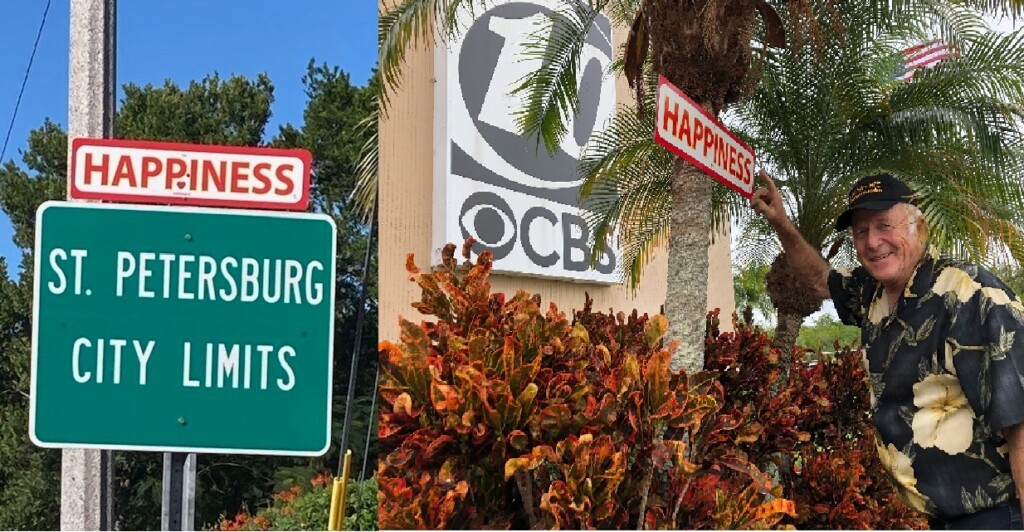 credit – the Happiness Experiment, retrieved from Facebook credit – the Happiness Experiment, retrieved from Facebook“That’s 602,” says Gary King, climbing down from a ladder propped up against a telephone poll, a red and white sign reading “HAPPINESS” newly affixed to its side. “All I’m doing is subliminal experiments using one word, one word. This word has been around forever but where do you see it? You don’t.” King has been hanging metal Happiness signs all over St. Petersburg, Florida, since 2019. It’s all part of The Happiness Experiment, a sociology project to subtly influence the population of his hometown through subliminal advertisement. Profiled in Fox News 13’s “Extraordinary Ordinaries” segment with Walter Allen, King says six proven sociological effects go into his work, the most powerful of which is what advertising companies have done for a century. By putting their logos everywhere, their products remain at the front of your mind. But what if instead of selling soft drinks or fast food, the goal of that advertisement was to put a smile on your face? That’s King’s mission. But as joyful as Gary King may seem driving around his home in his F150 wearing his official Happiness Experiment t-shirt and ballcap, the crucible of this happy work was the darkest depths of despair. In 2012, his son Brian took his own life, leading King into a spiral of unhappiness that almost resulted in him doing the same. The Happiness Experiment’s first test subject was none other than King himself. Today, King revels in messages received from Floridians who see the signs all over Florida and are affected by them. “I first saw the happiness experiment TB signs on the day of my miscarriage last year. The signs reminded me that it was all going to be okay, and that I could find happiness during and after this,” read a letter he received. In another letter, a woman bearing the burden of severe bipolar disorder almost ended her life—from the edge of the very same bridge King’s son Brian used to end his. But on her way there she saw one of the Happiness signs and turned around with fresh perspective. Perhaps that’s why King said the greatest gift he ever received was his suffering. Florida Man Deploys ‘Subliminal’ Advertising to Incite Happiness Through Viral Sign-Hanging Campaign |
Kia Motors roadshow in Zunheboto town receives positive response (2025-07-30T11:43:00+05:30)
 Zunheboto : Kia Motors, which made its debut in the Indian automobile market in August 2019, officially entered the Nagaland market in August 2024 with its dealership located at 6th Mile, near NSC Indian Oil Petrol Pump in Dimapur. As part of its state-wide outreach strategy, the company has been organizing roadshows and promotional campaigns across Nagaland, with a specific focus on engaging potential customers at the district level. One district that has drawn particular attention is Zunheboto, where company officials reported “an overwhelmingly positive response from residents.” Speaking to the media, the team leader from Kia highlighted that customers from Zunheboto have shown keen interest in Kia’s offerings, and reportedly, there have been no complaints or negotiation issues raised so far. “This,” the company stated, “reflects a strong potential market and an encouraging reception for their vehicles in the district.” “Our goal is to provide not just vehicles, but safety, comfort, and convenience. We're pleased to see the level of trust and interest shown by the people of Zunheboto,” the team leader remarked. Kia’s recent promotional efforts include showcasing upcoming models like the Kia Klavis EV, scheduled for launch later this month. While product highlights such as electronic stability control, parking sensors, and ADAS features were part of the demonstration, the broader objective remains to connect with communities across Nagaland. The company's roadshow strategy, according to representatives, “is not just a marketing campaign but also a response to the unique logistical and communication challenges of reaching remote regions.” It was stated that “by visiting districts directly, Kia aims to build trust and offer firsthand interaction with prospective customers.” In addition to vehicle demonstrations, Kia is also promoting “customer-friendly services such as wireless software updates via Kia Connect 2.0, smart access through mobile apps and digital keys, and service support through the MyKia app.” However, the company clarified that “while it offers car exchange services, vehicles from Ford, Renault, and Chevrolet are currently excluded from this policy.”Regarding financing, the team shared that government employees are eligible for a low down-payment scheme subject to salary verification, while in-house financing is available for all customers with proper documentation and a guarantor. Kia Motors roadshow in Zunheboto town receives positive response | MorungExpress | morungexpress.com |
Do you know what part of your marketing spend is actually working? (2025-07-14T12:11:00+05:30)
 Image: Willie Lawless/ Networld Media Group A panel at the Restaurant Franchising & Innovation Summit in Myrtle Beach will look at how brands are wasting their marketing money and how to get the most out of their ad spend. By Mandy Wolf Detwiler — Managing Editor, Networld Media Group Restaurant franchises are still struggling with a century-old marketing dilemma: knowing which half of their advertising spend is actually working. A session at the upcoming Restaurant Franchising and Innovation Summit, titled "Stop Wasting Marketing Dollars: Optimizing Media Spend for Restaurant Franchises," aims to tackle this challenge by exploring data-driven strategies to maximize ROI and customer engagement across all levels of a franchise organization. The Summit is being held in Myrtle Beach, South Carolina, March 11-13 and brings together restaurant operators and owners for a two-and-a-half-day workshop designed for education and fellowship. Session speakers include Samantha Hebel, director of marketing for Hungry Howie's Pizza and Subs; Erin Levzow, growth advisor for Batch & Box, Andy Linke, senior director of marketing for Ziggi's Coffee and Frank Solis, senior director of marketing for Taco Cabana. Corbett Guest, president and chief strategy officer for Imaginuity, serves as moderator. Imaginuity is sponsoring the session. Linke said in an email interview that restaurants tend to spend excess money on tech that doesn't talk to each other. With advancements in technology come more tools and new tools, Linke said. "Often [new tools] they are to make one task or one person's job easier. But with each new tool comes a larger and larger tech stack which creates the need for more resources to manage it and find the single truth from all the data." Levzow said restaurants often spend excessively by not tracking results effectively and failing to evaluate the ROI on the various platforms, services and management tools in use. "I recently was speaking to a brand that had 10 to 12 different platforms and all the systems were not even speaking to each other let alone tracking results without cannibalizing the other one. Tech consolidation could lead to significant savings by streamlining these resources, ensuring better investment returns, and creating more efficient operations," Levzow said. To harness customer data for improving targeting and conversion rates at the brand, regional and individual franchise level, Levzow recommends restaurants have all customer data set up in a customer data platform/data warehouse and parsed out for appropriate targeting. "If you can get 80% of your customer data in a usable format, you can target efficiently and cost-effectively at every level, from the brand to individual franchises, maximizing conversion rates and enhancing customer engagement." Linke said marketing is never a one-size-fits-all and restaurants need to measure and work with what's best for the organization. "Having a reliable loyalty/ customer capture program is important," he said. "It's always easier and cheaper to retain customers than it is to acquire but you need the right data and insight to do so effectively."The summit will be held at the Marriott Myrtle Beach Resort and Spa at Grand Dunes. Register here for the event. It is a Networld Media Group event, which also owns the Fast Casual Executive Summit and the Pizza Leadership Virtual Summit. Do you know what part of your marketing spend is actually working? |
Aggressive marketing has driven the rise of the double-cab ute on New Zealand streets — time to hit the brakes? (2025-06-05T13:25:00+05:30)
|
Kirsty Wild, University of Auckland, Waipapa Taumata Rau and Alistair Woodward, University of Auckland, Waipapa Taumata Rau “Explore your inner beast.” That was the slogan used last year to sell the Ford Ranger. At 2.4 tonnes, that’s a lot of “light” truck, but the stakes are rising. This year, the 3.5 tonne Ram 1500 “eats utes for breakfast”. Super-sized light trucks have landed in Aotearoa New Zealand. Eight out of the ten top-selling passenger vehicles are now utes or SUVs, with two-thirds registered for personal use. According to the Household Travel Survey, many journeys previously made using much smaller cars (such as shopping trips) are now made in these vehicles. And despite the recent protests from farmers and tradies about the so-called “ute tax”, the double-cab light truck has become very much an urban vehicle. When we looked at the marketing videos for these vehicles in New Zealand, utes or pickups enjoyed the most “masculine” marketing strategies. Themes of dominance and violence are strong: vehicles have names like “Raptor” and “Gladiator”, and are referred to as “muscular” and “beasts”. Much of the advertising involves images of aggressive driving — skidding and jumping, with the vehicle generally shot from below, travelling fast at the camera. SUV marketing is slightly more unisex and emphasises safety, luxury and envy. But here’s the problem: climate change is also super-sizing, as the recent extreme heat wave in the Pacific Northwest of the US and Canada and severe floods in Europe and elsewhere have reminded us. Light trucks on city streets are bad for the climate in two ways. Due to their weight and size, they emit more CO₂ than other vehicles: in a year’s typical driving, 100 Ford Rangers would emit 90 tonnes more CO₂ than the same number of Toyota Corollas. And large vehicles affect the urgent shift to low-carbon modes of transport, by obstructing footpaths because they’ve outgrown car parking, making cycling and walking more difficult and dangerous. Cyclists and pedestrians struck by one of these vehicles are roughly twice as likely to die or be seriously injured compared with a crash involving a small car. Nature as marketing toolIronically (but deliberately), nature and the ability to connect with the countryside are an enduring marketing theme for selling large four-wheel-drive vehicles to urban dwellers. As cultural historian William Rollins has pointed out, SUV marketing has exploited and twisted a “developing environmental consciousness” into demand for high-emission vehicles. In the process, time needed to develop cleaner vehicles was lost. In New Zealand, the shift to larger SUVs and utes has largely wiped out the fuel efficiency gains made over the past ten years. Globally, the SUV market was the only industry sector last year where CO₂ emissions continued to rise despite the pandemic. The growth in SUV sales has been identified as the second-most-important reason why CO₂ is continuing to rise. Not a new storyBut this isn’t a new story. Detroit auto journalist Keith Bradsher’s 2002 book, High and Mighty: SUVs – the world’s most dangerous vehicles and how they got that way, documents the now familiar risks: high emissions, deadly to other drivers and pedestrians, and prone to fatal “rollovers”. He also provides an extraordinary ethnography of the advertising strategy that formed around these vehicles — some of which now rival the size of a WWII tank. Marketed at our “reptilian” instincts for safety, dominance and connection to the natural world, it had a strong Hobbesian flavour. Life – particularly city life – is nasty, brutish and short. One must dominate or be dominated, even on that trek to the supermarket in search of cat food. Bradsher’s interviews with marketing executives revealed a deliberate strategy to market these vehicles to consumers with higher levels of egotism, insecurity and status anxiety. New Zealand research with SUV drivers has also shown they were more likely to agree with the statement that “most people would like a vehicle like mine”. Auto industry goldmineNew Zealand has been a dream market for urban light trucks. With weak emission standards and vehicle safety ratings that prioritise drivers over other road users, the regulatory frameworks have created an environment ripe for vehicle super-sizing. This, too, is a familiar story. The American pickup famously came about as a result of a trade war with Europe that locked foreign competitors out of the US market. The all-American pickup truck came to enjoy a range of exemptions from environmental and safety regulations. Since then they’ve been a gold mine, with profits on SUVs and utes much higher than on cars, and the auto marketing machine swinging in heavily behind these vehicles. Around 85% of Ford’s ad spend is now devoted to SUVs and utes. The US$35 billion global auto marketing industry is now largely focused on selling them, including into emerging markets in India and Brazil. Change is comingBig-budget marketing campaigns for these high-emission vehicles are now becoming a flashpoint over the role of the advertising sector in climate change. UK organisation Badvertising, which has called for an ad ban on the dirtiest third of these vehicles, argues advertising should be “named and shamed” like other industries that indirectly contribute to climate change (such as banking and investment). But the advertising industry itself may be part of the solution. Creatives working with governments on ambitious decarbonisation targets are speaking up about the “tide of misinformation” they face from corporate advertising. While marketing spends may still be weighted heavily in favour of the auto industry, there are ways of promoting smaller, cleaner, safer vehicles:
And finally, a big one: adopt new advertising codes of ethics to end the promotion of high-carbon lifestyles and products. Mia Wisniewski, Master of Public Health candidate at the University of Auckland, contributed to the research for this article. Analysis of SUV/ute advertising themes in New Zealand was undertaken as part of her MPH thesis. Kirsty Wild, Senior Research Fellow, Public Health, University of Auckland, Waipapa Taumata Rau and Alistair Woodward, Professor, School of Population Health, University of Auckland, Waipapa Taumata Rau This article is republished from The Conversation under a Creative Commons license. Read the original article. |

Consumers are wise to ‘woke washing’ – but truly ‘transformative branding’ can still make a difference (2025-05-19T13:30:00+05:30)
|
Amanda Spry, RMIT University; Bernardo Figueiredo, RMIT University; Jessica Vredenburg, Auckland University of Technology; Joya Kemper, University of Auckland, Waipapa Taumata Rau, and Lauren Gurrieri, RMIT University With brands increasingly engaging in social change campaigns and leveraging their influence to be “purpose-led”, the time has come to ask a couple of big questions: is this a viable strategy, and how sceptical should we be of so-called “brand activism”? In recent weeks alone, Ben & Jerry’s has launched a new ice-cream flavour called “Change is Brewing” to support Black-owned businesses and raise awareness of the People’s Response Act, proposed legislation to establish a new public safety agency in the US. Lego declared it would promote inclusive play and address harmful gender stereotypes with its toys. Mars Food rebranded Uncle Ben’s rice to Ben’s Original in response to criticisms of the racial caricatures in its marketing. At the same time, businesses have a chequered history when it comes to engaging with societal problems, from self-serving “box ticking” corporate practices under the guise of social responsibility to shifting responsibility to consumers to make ethical choices (such as reusable coffee cups). More recently, “woke washing” has seen brands promoting social issues without taking meaningful action. Consider fast fashion brands that promote International Women’s Day while simultaneously profiting from the exploitation of female workers. Change from within How then can brands legitimately shoulder responsibility to support or promote societal transformation? Our research introduces the idea of “transformative branding”. This involves companies working with customers, communities and even competitors to co-create brands that lead on both market and social fronts. Transformative branding can be achieved by for-profit organisations, not-for-profits and social enterprises. The common factor is balancing business and societal goals to create change from within the market system. Marketing concepts with a social edge have proliferated in the past 50 years, but finding actual solutions has been less successful. We ask how corporations can act to genuinely contribute to society and show how transformative branding can help brands shoulder that responsibility. Beyond making money Transformative branding works via two main market-shaping elements: leadership and collaborative coupling. These enable companies to partner with stakeholders to change their business landscapes. First, leadership involves building a vision for the transformation. This requires leaders to think flexibly and creatively, work to long time horizons and stay attuned to changing ideologies. This involves fundamentally re-imagining what branding can do – beyond making money. Second, collaborative coupling involves implementing this vision across the different dimensions of the brand. Key to this is mobilising stakeholders, including customers, employees, investors, suppliers, governments, communities and competitors. When the brand and its stakeholders collectively throw their weight behind the goal of transformation, it signals commitment, distributes expertise and resources and establishes legitimacy. Leadership and collaborative coupling work together to change the business environment. Our research shows this has ripple effects, creating opportunities for transforming economic, regulatory, socio-cultural and political environments. Transformative branding in practice Patagonia founder Yvon Chouinard is a good example of transformative branding at work, particularly in his candid admission that the notion of a fully sustainable business is “impossible”. Instead, Patagonia has reframed its priorities around responsibility, with Chouinard re-imagining the brand as a solution to environmental degradation. This vision is central to the brand’s iconic “demarketing” campaign, “Don’t buy this jacket”, which aims to shift the consumption ideology from purchase to repair. More recently, Patagonia’s “Buy Less, Demand More” campaign and its “Worn Wear” scheme for used apparel have brought the notion of a circular economy into the company’s strategy to promote a culture of reuse rather than always buying new. Dutch chocolate brand Tony’s Chocolonely demonstrates collaborative coupling in its campaign to clean up production and supply chain practices in the chocolate manufacturing industry, and to eliminate illegal child labour and modern slavery. The company’s “open chain platform” helps all industry players, including competitors, to foster equitable and transparent supply chains and ensure a living income is paid to cocoa farmers. The brand actively erodes its own potential competitive advantage in the process. Staying scepticalBut transformative branding is complex and dynamic, and authenticity is paramount. For instance, earlier this year, Tony’s was removed from watchdog organisation Slave Free Chocolate’s ethical producers list over its partnership with a major chocolate producer being sued for allegedly using slave labour. Tony’s responded by claiming it was important to educate and inspire business partners and competitors to adopt ethical principles and practices. This complex and often slow process of negotiating what it means to be ethical is all part of transformative branding. It adapts to the differing goals and values of many stakeholders. And while transformative branding offers a path towards a more sustainable and equitable future, we should continue to cast a critical eye on brands claiming to be a force for good, challenge them and hold them accountable where necessary. Amanda Spry, Lecturer of Marketing, RMIT University; Bernardo Figueiredo, Associate Professor of Marketing, RMIT University; Jessica Vredenburg, Senior Lecturer (Assistant Professor) in Marketing, Auckland University of Technology; Joya Kemper, Senior Lecturer in Marketing, University of Auckland, Waipapa Taumata Rau, and Lauren Gurrieri, Senior Lecturer in Marketing, RMIT University This article is republished from The Conversation under a Creative Commons license. Read the original article. |
