
.jpg) Ben Affleck continues to support Jennifer Lopez's professional endeavors, People reports. Lopez, 56, stars in the upcoming musical, Kiss of the Spider Woman, and appeared at the Monday, Oct. 6, New York City premiere. Along with Lopez, the film's executive producer, Affleck, made a surprise appearance at the N.Y.C. event. Affleck and Matt Damon’s Artist Equity production company co-produced the movie. At the premiere, the former couple posed together in celebration of the production. A few photos captured the two A-listers chatting with each other on the carpet. Affleck, 53, also spoke to the press about the film. For the occasion, Lopez wore a sculptural gown from Harris Reed's spring 2026 collection. Ahead of the screening, Lopez introduced the film and thanked her ex-husband, saying, “Thank you so much, thank you everybody for being here tonight. Thank you, Ben, this movie wouldn’t have been made without Ben and without Artist Equity.” “I read the script, if you know, I was in bed and I was just floored," she continued. "I was just like could this be happening right now. I get to sing, I get to dance, I get to act. I get to be an old-time Hollywood movie star." Affleck's supportive appearance follows their 2025 divorce. The former couple initially met in 2002 and began dating. After ending their engagement in 2004, they both pursued other relationships and started families of their own. Then in 2021, they rekindled their romance and they married in an intimate Las Vegas ceremony in July 2022. The next month, they celebrated their nuptials with a second ceremony in Georgia in front of friends and family.In 2024 they split, citing irreconcilable differences. They settled their divorce in February. Source: https://www.panorama.am/
|
Institute of Fashion and Modeling launched in Kohima (2025-08-25T13:06:00+05:30)
 Kuntanil Das, IFM Academy, Chairman of Vernajyoti Educare Rahul Akahury and others during a press conference at The Heritage, Kohima on May 7. (Morung Photo) Kuntanil Das, IFM Academy, Chairman of Vernajyoti Educare Rahul Akahury and others during a press conference at The Heritage, Kohima on May 7. (Morung Photo)Kohima | 25-08-2025, Institute of Fashion and Modeling (IFM) Academy, an institution in creative education was launched in an event in Kohima on May 7. Founded by senior show director and image consultant, Kuntanil Das, IFM Academy informed that it has its campuses in Kolkata and Siliguri. During the press briefing at The Heritage, Kohima, Das said that said IFM Academy is not just an institution, it’s a movement towards empowering creative minds. “Nagaland is rich in artistry, individuality, and raw talent. We are here to channel that energy into meaningful careers in design and fashion. Our Kohima chapter is a commitment to the youth of this state — to dream, learn, and lead with confidence,” he said. He informed that IFM Academy now brings its national reputation and quality programs to Kohima, offering a platform to nurture and empower the next generation of creative professionals in Nagaland. “Recognized for its industry-driven curriculum, real-world exposure, and international affiliations, IFM Academy is associated with global fashion powerhouse Istituto di Moda Burgo, Milan. The institution also serves as the state collaborator for Miss Universe India —West Bengal edition, offering students exposure to the glamour and fashion industry. At the Kohima campus, IFM Academy will offer structured programs in Fashion Design, Interior Design, and Professional Modeling & Grooming, designed to suit aspiring professionals, students, and creative enthusiasts alike. The Fashion Design program is tailored to help students master every aspect of the fashion industry— from garment construction, textile science, fashion illustration, and pattern making to marketing and trend forecasting. The course blends classroom learning with hands-on projects, fashion shows, portfolio creation, and internship opportunities, ensuring students are industry-ready with a global outlook. The Interior Design program combines technical precision with aesthetic development. Students will be trained in design theory, space planning, material studies, lighting techniques, 3D visualization, and the latest design software. The curriculum emphasizes Practical learning through site visits, studio-based workshops, and real-time project simulations. It also integrates principles of sustainable and vastu-compliant design, making it culturally relevant and contemporary. The Modeling and Grooming course is curated for individuals aspiring to become fashion models, pageant contenders, or public personalities. The program focuses on ramp walk techniques, body language, posture, camera confidence, grooming, and personality development. Regular portfolio shoots, interaction with fashion choreographers, and live fashion show participation provide a professional launch pad into the glamour industry. All these programs are skill-based, with a focus on practical training, industry immersion, and real-world assignments. Chairman of Vernajyoti Educare Rahul Akahury expressed honour to bring IFM Academy to the heart of Nagaland through this partnership. “At Vernajyoti Educare, we believe in nurturing potential and creating platforms for excellence. With IFM Academy’s expertise and our local insight, we are confident of transforming Kohima into a hub of fashion and design education,” he said. Akuhury expressed hope that this collaboration will open new doors of opportunity for the youth of the region, allowing them to compete, create, and conquer on a national and international stage.” Vernajyoti Educare, a sustainability and community development organization, also announced the launch of its new Vocational Institute in Kohima, Nagaland. The institute will initially offer programs in Hospitality Operations and Fashion Design, with plans to expand to additional skill-based programs in the near future. “We have witnessed the incredible potential among Nagaland’s youth during our employment-linked Hospitality Skill Development Programs over the past two years,” said Sandip Das, Founder & Director at Vernajyoti Educare. He said this new institute will provide structured pathways to harness that talent and create sustainable livelihood opportunities.” Some key highlights include Fashion Design Program which is being offered in collaboration with the IFM, providing industry-relevant curriculum and certification; Hospitality Operations Program with 100% Placement assured, building on the success of government-supported skill development initiatives conducted since 2023 among others. The institute is located at Keyake P. Khel, Below ATI, Near Shalom Baptist Church, Kohima and is a unit of Vernajyoti Educare. An inaugural Fashion Show was hosted at The Heritage featuring collections of fashion designers Suvagata Das, Tejas Gandhi, and Suman Bhagat. The showstopper for the evening was Miss Universe West Bengal 2024— Sushmita Roy. Institute of Fashion and Modeling launched in Kohima | MorungExpress | morungexpress.com |
Bringing Nagaland’s traditional, eco-friendly weaves to global stage (2025-06-14T12:22:00+05:30)
 Naga fashion designer, Bambi Kevichusa showcased her latest collection Bambi Design, at The Couture Chronicles in New Delhi on October 27. The couture show was organized by Anant Samagam at Travancore Palace. (Photo Courtesy: Anant Samagam) Nagaland’s traditional weaves and eco-friendly textiles made their mark on the global stage once again, at the 19th edition of the ‘Celebrating North East India Festival’ in Istanbul, Turkey. Naga fashion designer, Bambi Kevichusa captured the audience’s interest with her collection of eco-friendly textiles, traditional weaves, and designs, bringing the state’s rich cultural heritage into the spotlight.  Naga designer, Bambi Kevichusa with the models at the 19th edition of the ‘Celebrating North East India Festival’ in Istanbul, Türkiye on September 6. Her collection of eco-friendly textiles, traditional weaves, and designs brought Nagaland’s rich cultural heritage into the spotlight. (Photo Courtesy: NEIFT) Naga designer, Bambi Kevichusa with the models at the 19th edition of the ‘Celebrating North East India Festival’ in Istanbul, Türkiye on September 6. Her collection of eco-friendly textiles, traditional weaves, and designs brought Nagaland’s rich cultural heritage into the spotlight. (Photo Courtesy: NEIFT)Kevichusa was one of 54 prominent participants from Northeast India at this landmark event organised by the North East Institute of Fashion Technology (NEIFT). Over the years, the festival has displayed the region’s heritage in global locations like Washington, DC, and Milan, Italy, and it continued this legacy in Istanbul this year.  Models showcase Bambi Kevichusa’s latest collection, Bambi Design, at The Couture Chronicles on October 27 in New Delhi. (Photo Courtesy: Anant Samagam) Models showcase Bambi Kevichusa’s latest collection, Bambi Design, at The Couture Chronicles on October 27 in New Delhi. (Photo Courtesy: Anant Samagam)The event was held in collaboration with the Consulate General of India in Istanbul and received support from the Indian Ministry of Textiles and various state governments from Northeast India, promoting the region’s tourism, textiles, and handicrafts sector to an international audience. In a recent interview with The Morung Express, Kevichusa reflected on her experience, sharing her insights into eco-fashion and her passion for all things ‘Nagas.’ “It has been a wonderful experience and a privilege to represent ‘our people’ in a foreign country,” she says, now back with fond memories and inspired by the warmth of the Turkish people.  A model showcases Bambi Kevichusa’s collection of eco-friendly textiles and designs in Istanbul, Türkiye at the ‘Celebrating North East India Festival’ on September 6. (Photo Courtesy: NEIFT) A model showcases Bambi Kevichusa’s collection of eco-friendly textiles and designs in Istanbul, Türkiye at the ‘Celebrating North East India Festival’ on September 6. (Photo Courtesy: NEIFT)Her collection showcased timeless pieces made from sustainable, organic, and locally produced textiles from Nagaland. “While we are used to our own culture and fabrics, for them, it was something entirely new.” “Being overjoyed is an understatement,” she adds, describing the enthusiastic response from both the public and the diplomatic fraternity. She incorporated Naga music into the fashion show, featuring the song Warrior’s Call by Colored Keys. With over a decade in fashion, Kevichusa’s work has reached audiences in Hanoi, Vietnam, Paris, and across India, most recently at The Couture Chronicles in New Delhi on October 27, organised by Anant Samagam at Travancore Palace. Despite her experience, the celebrated designer approaches each show not knowing how it would be received. “All I know is that I give my best effort. Sometimes I feel I could have done more, but I strive to the best of my ability and go ahead with it, really not knowing what to expect.”  Models showcase Bambi Kevichusa’s latest collection, Bambi Design, at The Couture Chronicles on October 27 in New Delhi. (Photo Courtesy: Anant Samagam) Step toward eco-friendly textiles: Kevichusa’s commitment to pursue eco-friendly textiles stems from a concern for the planet. “The inspiration comes from the burden of seeing climate change affect our land and the world around us,” she says. “And really, it is for my son,” she continues. “I have a 16-year-old, and I want to keep this planet safe for his generation and the next.” It also stems from her love for Naga traditional textiles which are naturally eco-friendly, as she observes that the Naga tradition is “much more advanced” in sustainability. In this light, she says that to address climate change, “we need to go back to our roots,” especially as the planet faces environmental devastation. “I can’t just sit still and do nothing, so this is my humble way of contributing.”  Models showcase Bambi Kevichusa’s latest collection, Bambi Design, at The Couture Chronicles on October 27 in New Delhi. (Photo Courtesy: Anant Samagam) Kevichusa pointed out that the fashion industry is one of the biggest contributors to environmental harm. “As designers, we have a responsibility, each one of us.” The fast-paced production cycles, synthetic dyes, petroleum-based fabrics, and plastic-based textiles—all are detrimental to the environment. She emphasised the need for designers to carefully examine the materials they use. “We need to go back to using recycled or natural fibres and eco-friendly dyes. This is our contribution to stopping the damaging effects of climate change.”  Whenever the bridal designer exhibits her work outside Nagaland, she takes the opportunity seriously. “The Nagas have something unique to give to the world, and I want people to know more about us.” So, Kevichusa makes sure that she showcases only Naga textiles and rich motifs rather than her bridal designs, representing the Naga people through clothing and fashion. Reflecting on her recent experience in Turkey, she recalls, “I was all by myself, even though the consul general is also Naga. I felt a big responsibility to represent our culture and people in a positive light.” Sustainable fashion has future, though with challenge : Kevichusa believes that sustainable fashion has a promising future in Nagaland. “Our roots, our textiles, our colours are eco-friendly. This is something unique we can offer the world.”  However, one major challenge she faces is sourcing organic textiles. “It’s difficult to find weavers who work with organic textiles, because everybody is caught up with their own work,” she explains. Finding these yarns remains a challenge, and there is limited handloom fabric, even as she admits that there have been many times when she felt like giving up. According to her, the local textiles made from loin and backstrap loom are not as durable for making clothes, so she uses fly shuttle loom fabrics. However, only a few weavers are producing these fabrics in eco-friendly fibres like silk and cotton, posing a hurdle for eco-friendly practices.  Models showcase Bambi Kevichusa’s latest collection, Bambi Design, at The Couture Chronicles on October 27 in New Delhi. (Photo Courtesy: Anant Samagam) Focus on originality, positive aspects: For aspiring designers aiming to make an impact, Kevichusa stresses the importance of originality. “Everyone has something unique to give to the world. You don’t need to copy others to make a mark, locally or globally. Be original, work consistently, and keep showing up. It is always a lot of hard work and sacrifices along the way, but if you’re good in your work, people will eventually find you.” She urges Nagas to value their heritage and focus on the positive aspects of their culture. “We have so much artistic heritage and treasure within us,” she says, “and that is our unique gift to the world—not just in fashion, but in every sense as a people.”“I think we often look at ourselves and say, ‘Oh we Nagas are like this and like that,’ speaking negatively about ourselves. We need to stop this. Instead, let’s start focusing on the positive things, pick those, and share them with the world.” Bringing Nagaland’s traditional, eco-friendly weaves to global stage | MorungExpress | morungexpress.com |
Digital clones of real models are revolutionizing fashion advertising (2025-05-13T11:29:00+05:30)
|
Driven by advances in artificial intelligence (AI) and metaverse technologies, digital clones are transforming fast-fashion marketing. Always available, ageless and adaptable to any setting, these virtual figures enable brands to create immersive, cost-effective campaigns that resonate with today’s digital-first consumers. Virtual influencers — digitally created personas used to provide entertainment, generate content and endorse brands — are becoming increasingly influential, especially among Gen Z and digital-first audiences. These virtual figures vary in form: some, like Lil Miquela and Shudu, are entirely computer-generated, while others, such as Hatsune Miku, incorporate human elements like voice or motion. Hybrid influencers blend real and virtual components, allowing for brand-specific customization. These virtual influencers boost brand visibility, drive engagement and influence market performance. Real persons, virtual personas The estimate for global influencer market size for 2024 was valued at over US$24 billion and is projected to grow to over US$32 billion in 2025. The rise of virtual influencers is particularly prominent in Asia. This trend is also reshaping the US$2.5 trillion modelling industry, according to The Business of Fashion. AI-generated avatars and digital clones enable brands to cut production costs and accelerate campaign development. As a result, companies such as Levi Strauss & Co. are partnering with AI modelling firms to integrate these virtual personas into their marketing strategies. Digital twins Digital twins — virtual replicas of real people — are gaining traction in marketing to enhance personalization, streamline content creation and deepen customer engagement. In the fashion world, they provide a means to maintain a sense of human connection while using AI for precision and volume purposes. Fast-fashion retailer H&M recently introduced AI-generated digital twins of real-life models for advertising and social media content. Positioned as a creative and operational aid rather than a replacement for human talent, the initiative has ignited industry-wide debate. While the brand highlights the advantages — lower production costs and faster catalogue development — some critics have raised ethical concerns regarding representation and transparency. These digital twins fall into the category of “front-of-camera” tools: static avatars used in visual content without independent personas or social media presence. Unlike virtual influencers, they do not interact with audiences or build followings. Instead, they function strictly as visual stand-ins for traditional models, who are compensated for the use of their likenesses, similar to conventional campaigns. As these avatars do not speak, endorse or engage directly with consumers, they remain subject to traditional advertising regulations — not influencer marketing laws. Digital models are used for operational efficiency: testing and refining creative strategies before rollout, reducing costs and potentially offering immersive digital experiences to enhance customer connection and brand loyalty. Authenticity and other challenges In July 2024, fast-fashion retailer Mango launched its first advertising campaign featuring AI-generated avatars to promote a limited-edition collection for teenaged girls. These AI-generated influencers and digital twins introduce numerous ethical and legal challenges. These innovations raise difficult questions about the displacement of human talent — including models, make-up artists, hairstylists and photographers — and broader implications for creative industries. Key concerns centre on consent and compensation. The unauthorized use of an individual’s likeness, even in digital form, poses a risk of exploitation and underscores the importance of clear standards and protections. The legal landscape regarding image rights and intellectual property is still evolving, which makes compliance both essential and complex. As the lines between reality and digital fabrication blur, brands risk eroding consumer trust. The authenticity that audiences value can be undermined if AI-generated content seems deceptive or inauthentic. Companies must tread carefully, balancing innovation with transparency. Diversity is another critical issue. While AI offers customization, it can also perpetuate biases or create an illusion of inclusivity without genuine representation An Associated Press report on AI models and diversity. As the use of AI proliferates, ensuring that digital models support, rather than hinder, meaningful advancement in representation will be essential. Ultimately, brands must implement ethical frameworks to ensure that AI enhances creativity while maintaining integrity, inclusivity and legal accountability. Strategic considerations Digital clones provide fast-fashion brands with a powerful tool to create personalized shopping experiences and enable greater representation of diverse body types and style preferences. This degree of customization can significantly enhance customer satisfaction and brand loyalty. To ensure ethical integration, transparency is crucial. Brands must clearly disclose when digital models appear in campaigns. These digital representations should encompass a wide variety of demographics to genuinely promote inclusivity and engage with a broader audience. Establishing ethical and legal safeguards is equally important. Creating digital clones requires explicit consent and careful attention to intellectual property rights. Without clear guidelines and permissions, brands risk violating privacy, misusing likenesses and facing legal repercussions.  Luana Carcano, Lecturer, Beedie School of Business, Simon Fraser University This article is republished from The Conversation under a Creative Commons license. Read the original article. |
‘Cultural expression through dress’: towards a definition of First Nations fashion (2024-12-31T14:21:00+05:30)
|
Treena Clark, University of Technology Sydney and Peter McNeil, University of Technology Sydney This May, Wiradjuri woman Denni Francisco and her label Ngali will be the first Indigenous designer to have a solo show at Australian Fashion Week. This is a long time coming for the First Nations fashion industry and the designers and artists who have laboured in the fashion space for many years. In 2003, Dharug woman Robyn Caughlan was the first Indigenous designer to show her ready-to-wear collection at Australian Fashion Week. Over the past 20 years, many Indigenous designers have shown their work in group shows. Francisco’s solo show is an important step forward for the industry. But First Nations fashion is not just about the catwalk. It is a politically charged practice. We need to have a discussion on what we mean when we say “First Nations fashion”. What is ‘fashion’? During the European colonial reign from 1788 into the 1860s, Australian administrators were shocked at the appearance of Indigenous populations, often imposing new forms of clothing. To them, Indigenous peoples were generally seen as wearing insufficient, “unsophisticated” and “static” clothing. From the 19th to early 20th century, sociologists argued only modern, urban societies like France had a fashion “system” of production, business and the trickle down of styles. By the 1970s, UK and US researchers started to use the word “dress” instead of “fashion” to connect wider forms of clothing, bodily and cultural practices. “Fashion” has, however, been used as far back as the 1970s to describe Australia’s emerging First Nations textiles, garment and runway shows. Recently, First Nations researchers in Canada and the United States discussed using “Indigenous fashion-art-and-dress” to describe First Nations clothing practices, fashion design and integration of art. In Australia we have not yet had a conversation about a term that could encompass fashion design, textiles and art. Important First Nations fashion associations, organisations, groups, and projects have attempted their own terms and strategies. We need a phrase which includes everything from wearing Aboriginal flag t-shirts in the city, self-designed outfits in the Tiwi Islands and commissioned garments in galleries and museums. Many First Nations designers are not designing for the fashion industry or galleries which sell their work as art. They are designing to break colonial bonds, share cultural stories, and provide a wearable form of wellbeing. A matter of style: We have been exploring the words that Australian First Nations fashion researchers, designers, artists and producers use to describe their work and the industry. The new millennium has motivated a great flowering of new First Nations designers and artists. They describe themselves using words such as fashion designer, artist, curator and their work as fashion and art and fashion labels. They variously describe their work as being Aboriginal, Torres Strait Islander or First Nations owned, or specifically emphasise their cultural Nations and groups. Artist Elisa Jane Carmichael (Quandamooka) calls traditional and cultural clothing and adornment “the first creations of Australian fashion”. Writer Tristen Harwood (First Nations) has written about the difference between “style” and “fashion”. He defines First Nations fashion as the marketing and buying of Indigenous designed fashions. By style, Harwood means the dynamic process of dressing that touches on identity, politics, self-creation and culture. Style is about wearing attire, in all its complexity, and includes the long history from forced clothing to the revival of cultural garments and looks. This distinction between fashion and style also informs Magpie Goose co-owner and director Amanda Hayman (Kalkadoon and Wakka Wakka). She notes how “Aboriginal cultural identity was systematically repressed” from the early 1800s to the late 1960s. With this repression, she argues, “cultural expression through dress was significantly impacted”. Now, a new generation of fashion figures such as teacher and designer Charlotte Bedford (Wiradjuri), National Gallery of Victoria curator Shanae Hobson (Kaantju) and @ausindigenousfashion founder and curator Yatu Widders Hunt (Dunghutti and Anaiwan) prefer the terms “Indigenous fashion” or “First Nations fashion”. Moving forward: While there is a wide range of terminologies and languages used within the First Nations fashion sector, it is time for a bigger discussion about a collective and holistic term. By embracing a holistic term, First Nations fashion would have a new and inclusive definition. It could acknowledge both traditional and contemporary practices of our First Nations peoples, including the role of artists, and encompass everything from fashion runways to creating garments for galleries, as well as everyday First Nations style. First Nations fashion is political. If you dig deep into fashion stories you will also hear many tales about racism, exclusion and discrimination, as well as survival and healing. We are moving into a new chapter of truth telling and the sharing of how racism and discrimination have influenced First Nations clothing practices and the fashion industry. In landing on a collective term we might better represent First Nations peoples’ fashion, art and style stories as well as their community, cultural and design contributions – the business of fashion in Australia itself.  Treena Clark, Chancellor’s Postdoctoral Indigenous Research Fellow, Faculty of Design, Architecture and Building, University of Technology Sydney and Peter McNeil, Distinguished Professor of Design History, UTS, University of Technology Sydney This article is republished from The Conversation under a Creative Commons license. Read the original article. Treena Clark, Chancellor’s Postdoctoral Indigenous Research Fellow, Faculty of Design, Architecture and Building, University of Technology Sydney and Peter McNeil, Distinguished Professor of Design History, UTS, University of Technology Sydney This article is republished from The Conversation under a Creative Commons license. Read the original article. |
Sahil Salathia Showcases Indian Fashion At New York Fashion Week (2024-02-10T13:00:00+05:30)
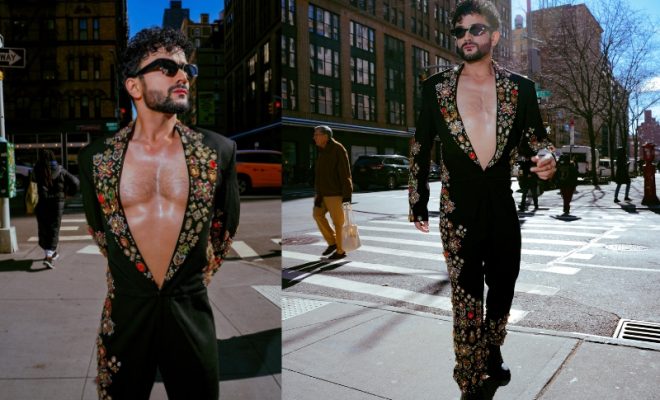 By Bharat Gatha, February 10, 2024, Actor Sahil Salathia is set to represent Indian designers Siddartha Tytler and Abu Jani Sandeep Khosla at New York Fashion Week. Known for his bold and quirky fashion sense, Sahil will be attending various top-tier shows during the event, including those by Indian designers Bibhu Mohapatra and Naeem Khan, as well as international brands like Coach and Michael Kors. He will be wearing outfits from Indian designers to promote Indian culture and showcase the creativity of Indian fashion on an international platform. Sahil’s collaboration with Abu Jani Sandeep Khosla is particularly significant, as he believes they understand his style the best and consider them to be one of the top-notch designers in India. He will be wearing a jumpsuit from their collection, which features Indian jewels and represents the cultural strength and beauty of India. The Fall 2024 season of New York Fashion Week is set to take place from February 9-14. The official schedule released by the CFDA promises an exciting lineup of designers and shows. On the first day, Peter Do showcased his sophomore collection as the creative director of Helmut Lang. Other notable designers opening the fashion festivities include Collina Strada, 3.1 Phillip Lim, and Prabal Gurung. Closing out the week on February 14 will be Brandon Maxwell and CFDA chairman Thom Browne, who is making a return to the NYFW schedule for the Fall 2024 season. This event to represent fashion designers at New York Fashion Week is a proud moment for fashion designers. Sahil’s unique style and fashion sense have always been the talk of the town, and now he has the chance to showcase the country’s tradition and creativity to a global audience. In addition to his fashion endeavors, Sahil has some exciting projects in the pipeline, which will be officially announced soon. Sahil Salathia is promoting Indian designers and their creativity on the global stage of New York Fashion Week, which may help to improve the reputation of Indian fashion worldwide. Sahil Salathia Showcases Indian Fashion At New York Fashion Week |
Museum Celebrates ‘Summer of Love’ 50th Anniversary in Amazing Collection of Fashion, Art & Music (2016-06-16T13:45:00+05:30)
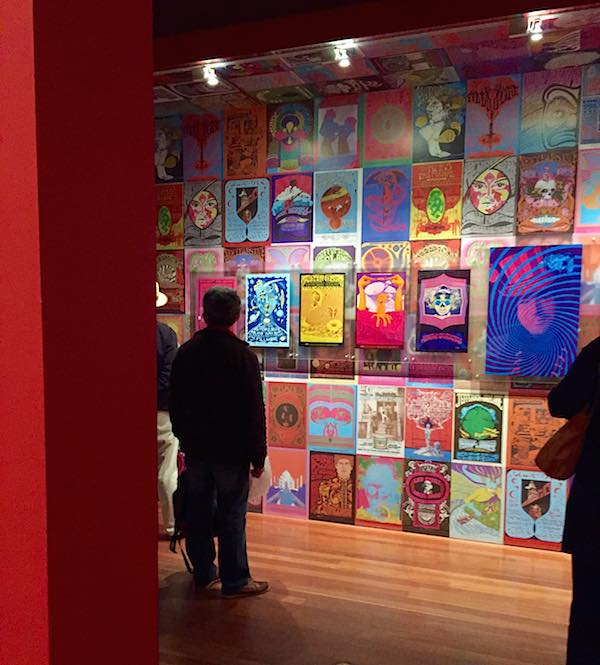 By Good News Network-Jun 16, 2017, It was the summer that changed everything… From growing discontent over the Vietnam war, which necessitated the drafting of 40,000 young men into military service each month, to the blossoming music scene with its psychedelic colors and consciousness-altering drugs, 1967 was fast becoming a fulcrum for change in American cultural history. 50 years ago today, The Monterey Pop Festival opened the floodgates for all that would define the legendary ‘Summer of Love’. The festival marked the first major US appearance for Jimi Hendrix, The Who, Janis Joplin, and Ravi Shankar. It secured California as the focal point for the counterculture movement and became an inspiration for future music festivals, like Woodstock two years later. (Learn more and watch the documentary trailer) San Francisco’s de Young Museum is celebrating the half-century anniversary with an exhibition that features more than 300 significant cultural artifacts that recall the art, fashion, and political discourse of the era — and, of course, the music, which provided the drum beat for a youth-driven revolution. Despite being a millennial, my parents were successful in raising me to love the same kind of music they grew up with (e.g. The Beatles, The Who, Jimi Hendrix, Bob Dylan). My peers and I were also eager to adopt the hippie fashions that eventually came back around in style—as you can see from my recent visit to the de Young… 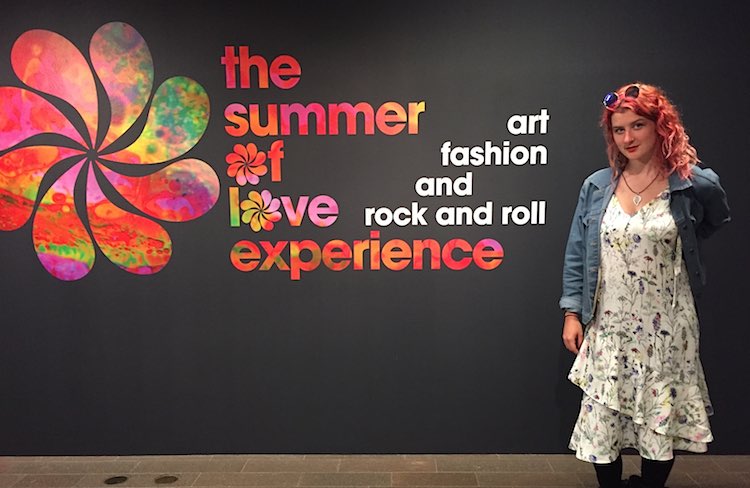 Yet, after going to see the exhibit, “The Summer of Love Experience: Art, Fashion, and Rock & Roll,” I was forcefully reminded that I had no idea what it was like back then. The closest thing that 20-somethings like me can use for comparison to the Summer of Love is Burning Man – but, that involves all generations, not only mine, and in terms of cultural impact, the two don’t even come close. 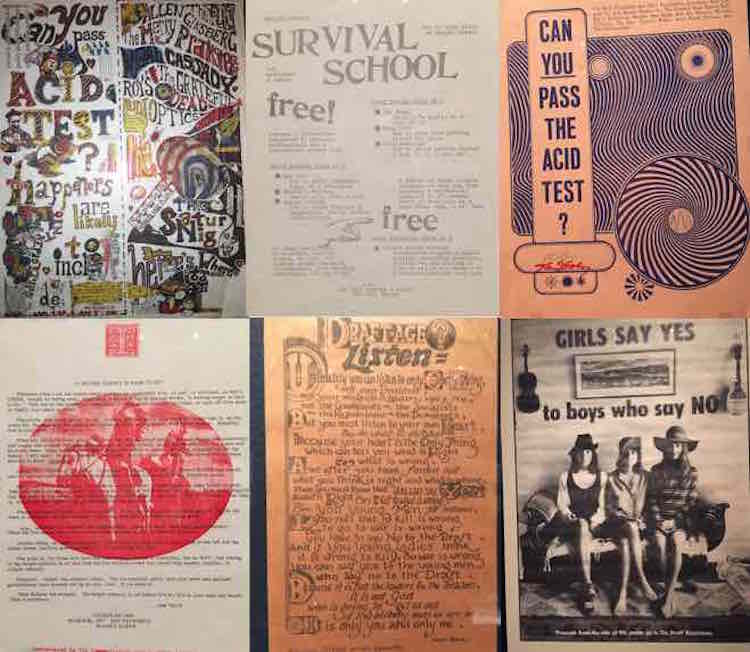 Besides an amazing array of hand-crafted fashion from the day, including the story of how a local seamstress got Levi Strauss to create the fist bell bottom jean, the exhibit featured informational flyers to give direction to the thousands of young people who left home to make a new life in San Francisco. Posters included the one made by Joan Baez (above, bottom right) to encourage girls to only “say yes to boys who say no” to the draft, and helpful hints for newcomers about how to avoid bad drug trips and where to get free food (top, center). There were even tips about how to deal with the police officers who were rounding up youth and trying to reunite them with their worried parents. 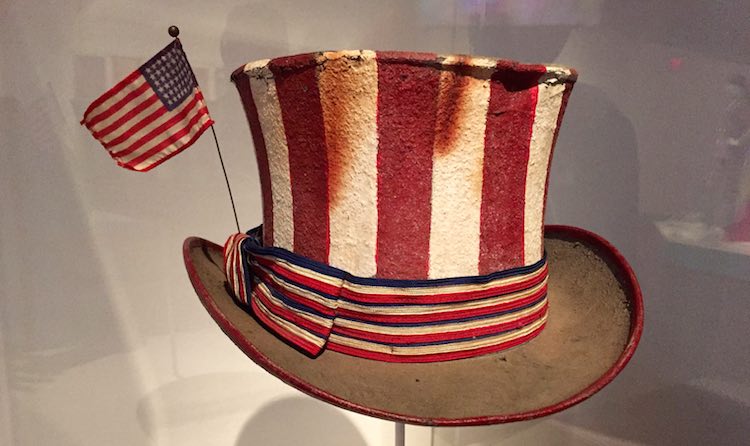 The original Captain Trips hat worn by Jerry Garcia The original Captain Trips hat worn by Jerry GarciaRock-poster artists such as Rick Griffin, Alton Kelley, Victor Moscoso, Stanley Mouse, and Wes Wilson, all generated an exciting array of distinctive works that summer emblazoned with distorted hand-lettering and vibrating colors (below). In various rooms of the exhibit, wild light shows were dazzling the visitors, such as the creations of Bill Ham and Ben Van Meter that served as expressions of the new psychedelic experience. 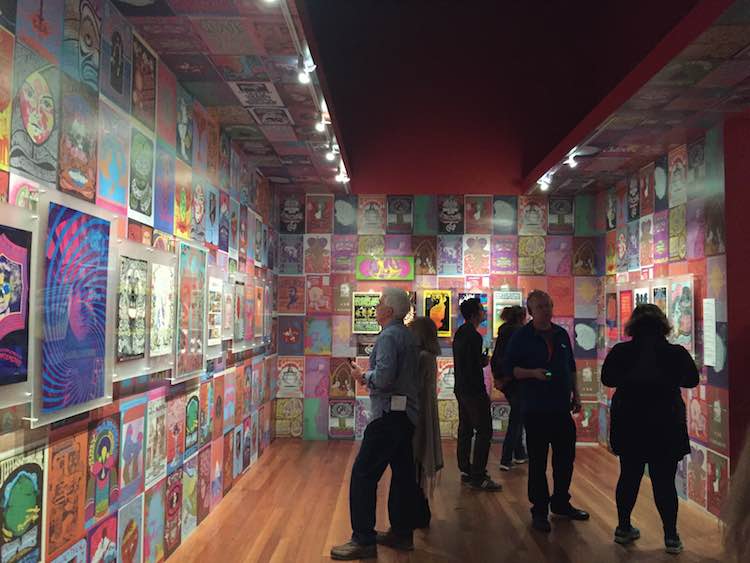 After leaving the museum, I headed over to Haight-Ashbury, the magnetic San Franciscan neighborhood that became a magnet for as many as 100,000 young people from all over disillusioned America – and while it’s been 50 years since the original Summer of Love, many of the original inhabitants of the neighborhood are still there to this day, as living relics of decades past. One such resident was Franklin: an original “tertiary acquaintance” of none other than “Uncle Ken” – the pseudonym of One Flew Over the Cuckoo’s Nest author and psychedelic revolutionary Ken Kesey. 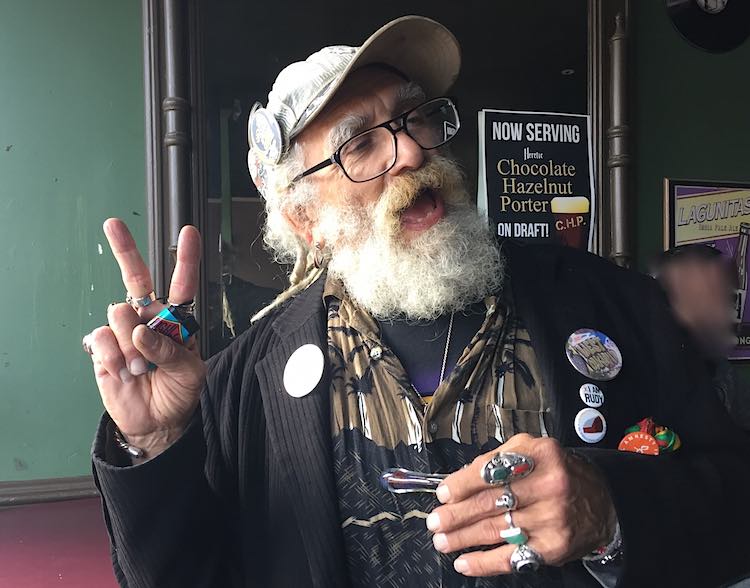 When asked about his recollections from those old friendships, he remembered fondly some advice he took to heart. “As Uncle Ken always used to say… ‘Stay in your own movie, man,” he said chuckling, before wandering outside to smoke a bowl of “medical marijuana” and inspect the buttons for sale on the sidewalk. 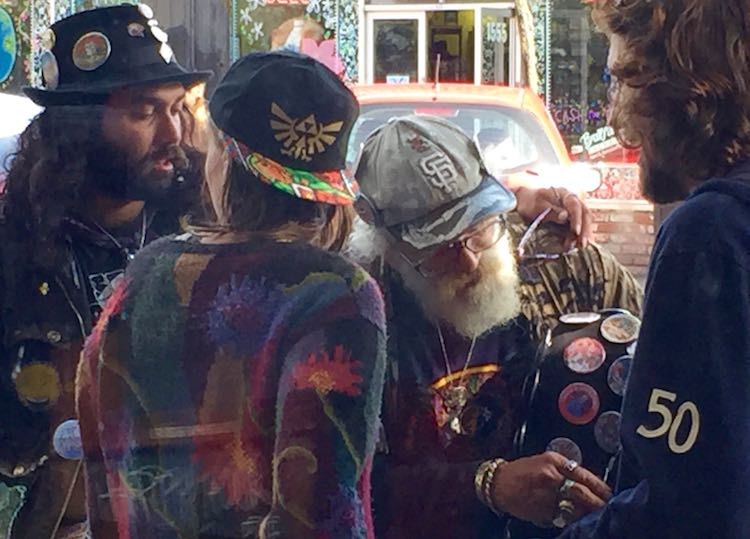 If you’re interested in catching a glimpse of one of America’s most pivotal eras–and definitely the most colorful one, the de Young exhibit runs through August 20, 2017 – and the hippies who lived through it are ‘feelin’ groovy’ not far away. Museum Celebrates ‘Summer of Love’ 50th Anniversary in Amazing Collection of Fashion, Art & Music
|
Selena Gomez's Indian avatar: Sari, bindi, bangles (2014-05-29T20:03:00+05:30)

May 24 Hollywood singer and fashion icon Selena Gomez took a break from wearing sensual dresses and skirts, to drape a traditional Indian sari and completed the look with bindi, bangles and a neckpiece. The 21-year-old, who is reportedly in Nepal on a mission as a UNICEF goodwill ambassador, managed to mesmerize her fans by her India-inspired look in an orange sari and a bindi matched up perfectly with open wavy hair. She posted a photograph of herself in this 'desi avatar' on photo-sharing website Instagram, and wrote: "Sari, not sari." The message was accompanied with a "Namastey" symbol with joined palms, though it was not revealed whether she was wearing a designer sari or not. However, this is not the first time Gomez has donned a bindi. She wore it first for the video of her hit song "Come and get it". Since then, she liked this fashion accessory so much that she opted for it several times. Gomez was also spotted with a bindi in Tarzana, California earlier this year. She again posted a picture of herself with a bindi March 4 this year. Celebrities like Madonna, Vanessa Hudgens, Sarah Hyland and Kendall Jenner also showed their love towards the bindi in the past. Source: Article, Image: flickr.com
|

Birla Cellulose, Sandy Macleenan tie-up for latest trends (2014-03-14T08:44:00+05:30)
 Birla Cellulose is collaborating with Sandy Macleenan, fabric specialist to get international trends to India. The collaboration aims to bring never seen before or exclusive trends to the country. Macleenan with his knowledge on trends and international insights plans to adapt them to Indian sensibilities. A creative partnership for new trendsThe collaboration will also look at all the various possibilities of using cellulosic fibres. Macleenan feels the Indian market is massive with loads of categories. It has enormous potential and Birla Cellulose as a fashion forward company and pioneer in the fabric category has a huge role to play. To achieve the desired results, Birla Cellulose is leveraging its human resources to make things from scratch and R&D is being carried at their units. Macleenan reveals, “We are not replicating but learning and inventing things in a way within this R&D facility. The aim is to produce a range of things which kind of mutates the trend that we started with and arrives looking exactly the same towards the end as it was in the beginning because of several influences and then we can package it into hardcore merchandising trends that can be made ready to sell for people to buy atretail level.” Apart from the domestic market, Birla Cellulose is also looking at showcasing its trends on a global platform. This collaboration will further look at bringing out a credible and believable collection matching the standards of Birla Cellulose. It is just the beginning and certainly a step towards beginning a dialogue on the global platform. “I am interested in seeing how trends get linked into business and become like an amplifier, they become a thing that generates more discussion, more noise, creates more interest and generates real things which will be in the end the value of what we do to make things that people want,” adds Macleenan. He further adds, “At one point Birla Cellulose would be turning its vision towards the rest of the world to supply into other markets, more northern markets and the product will in the end mutate into creating a much more strong seasonal contrasts.” Talking about his expectations from India, Macleenan says, “My expectations from my relationships here is to upgrade what is currently available by making it more and giving it more beauty, a little bit more of an intrinsic feel to the fabric rather than pretty so that you are looking at core values that are really posh, means it is more even, more perfect, quality being more steady by not adding more price but adding class to it. Source: Article Birla Cellulose is collaborating with Sandy Macleenan, fabric specialist to get international trends to India. The collaboration aims to bring never seen before or exclusive trends to the country. Macleenan with his knowledge on trends and international insights plans to adapt them to Indian sensibilities. A creative partnership for new trendsThe collaboration will also look at all the various possibilities of using cellulosic fibres. Macleenan feels the Indian market is massive with loads of categories. It has enormous potential and Birla Cellulose as a fashion forward company and pioneer in the fabric category has a huge role to play. To achieve the desired results, Birla Cellulose is leveraging its human resources to make things from scratch and R&D is being carried at their units. Macleenan reveals, “We are not replicating but learning and inventing things in a way within this R&D facility. The aim is to produce a range of things which kind of mutates the trend that we started with and arrives looking exactly the same towards the end as it was in the beginning because of several influences and then we can package it into hardcore merchandising trends that can be made ready to sell for people to buy atretail level.” Apart from the domestic market, Birla Cellulose is also looking at showcasing its trends on a global platform. This collaboration will further look at bringing out a credible and believable collection matching the standards of Birla Cellulose. It is just the beginning and certainly a step towards beginning a dialogue on the global platform. “I am interested in seeing how trends get linked into business and become like an amplifier, they become a thing that generates more discussion, more noise, creates more interest and generates real things which will be in the end the value of what we do to make things that people want,” adds Macleenan. He further adds, “At one point Birla Cellulose would be turning its vision towards the rest of the world to supply into other markets, more northern markets and the product will in the end mutate into creating a much more strong seasonal contrasts.” Talking about his expectations from India, Macleenan says, “My expectations from my relationships here is to upgrade what is currently available by making it more and giving it more beauty, a little bit more of an intrinsic feel to the fabric rather than pretty so that you are looking at core values that are really posh, means it is more even, more perfect, quality being more steady by not adding more price but adding class to it. Source: Article |
Hollywood beauties take to Indian designs (2013-11-28T21:29:00+05:30)

Heavy embellishment sarees with beautiful authentic zari, stone, bead, sequin andzardosi work makes my heart miss a beat. These traditional works make Indian saree's overall look enchanting. You can opt for the rich zari designer saree or a light saree with that has heavy work for your wedding. When I asked a few of my friends what kind of Saree they will like to wear during any Indian function. "I love pinks and shades of pinks. A nice lehenga designer saree with beautiful zari work is my favorite" says Rachel one of my friend who
 is settled in NewYork since 1985. "I will love to team it with a polki set or maybe with a heavy pair of jhumiks" she added. "Indian saree makes me look stunning. I love the way it looks and draped" says Shruti one of my other friend who has this immense love for net sarees. She loves to wear net lehenga sarees with heavy embroidered pallu or dupatta. She also likes to team up her saree with a long choli which is the latest is settled in NewYork since 1985. "I will love to team it with a polki set or maybe with a heavy pair of jhumiks" she added. "Indian saree makes me look stunning. I love the way it looks and draped" says Shruti one of my other friend who has this immense love for net sarees. She loves to wear net lehenga sarees with heavy embroidered pallu or dupatta. She also likes to team up her saree with a long choli which is the latest  trend nowadays. My south Indian friend Anupriya loves Half and Half saree which she says she loves to team up with a brocade blouse to give that ethnic look. Fabric and color plays a major role So, think about the comfortability and the taste zone as you will surely be able to adapt the Saree in the fabric and color that suits your body type. No need to wander around for your love for designer saree. Check out Cbazaar for the latest chic and stylish sarees online. It is a leading online store offers exclusive Indian and Pakistani clothes. Cbazaar deals in Bridal wear and salwar suits that include Patiala suit, Bollywood Bridal lehenga. Also the range of blouses offered by Cbazaar covers both daily use as well as designer wears for special occasions Source: Link.. trend nowadays. My south Indian friend Anupriya loves Half and Half saree which she says she loves to team up with a brocade blouse to give that ethnic look. Fabric and color plays a major role So, think about the comfortability and the taste zone as you will surely be able to adapt the Saree in the fabric and color that suits your body type. No need to wander around for your love for designer saree. Check out Cbazaar for the latest chic and stylish sarees online. It is a leading online store offers exclusive Indian and Pakistani clothes. Cbazaar deals in Bridal wear and salwar suits that include Patiala suit, Bollywood Bridal lehenga. Also the range of blouses offered by Cbazaar covers both daily use as well as designer wears for special occasions Source: Link.. |
Brazilian wins transgender pageant in Thailand (2013-11-25T21:04:00+05:30)

A Brazilian has won the 9th Miss International Queen transgender beauty pageant in Thailand, with US and Thai contestants placing second and third. Marcelo Ohio won first prize which included 300,000 baht (9,677 dollars), a crown with real gemstones and free surgery "for anything" at a famed plastic surgery clinic in Bangkok, organizers said. The pageant held in the beach resort of Pattaya since 2004, ended around midnight Friday. US citizen Shantell D'Marco came second in the beauty pageant, with Thai contestantNethnapada Kanrayanon placing third. There were 25 contestants from 17 countries in this year's contest, organized by the Tiffany's Show Pattaya Company, including three from Brazil. The show was launched 40 years ago to provide Pattaya beach resort, 100 kilometres south-east of Bangkok, with a novel form of entertainment while offering transgenders a legitimate career option, said Arisa Phanthusak, Tiffany's manager and organizer of the Miss International contest. In 2004, the show went international, offering transgenders from other countries an opportunity to bask in the limelight. "After Thailand, I think the Philippines and Brazil are the countries that are most tolerant of transgenders," Arisa said. Transgenders are numerous in Thailand, where many have found successful careers in the entertainment, fashion and cosmetics sectors and even in government service. "It is in our character to be tolerant," Arisa said. "We are free here, and we are service-oriented people," she said. Source: The New Age, New Zealand, 11/2/2013. Source: Article
|